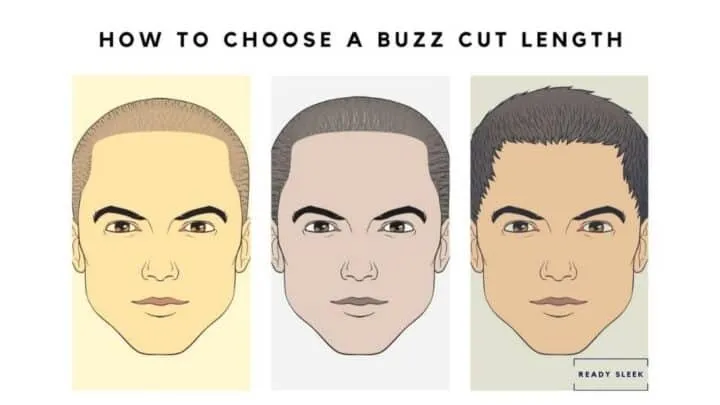
The best buzz cut length is the shortest length you actually like wearing, not the shortest guard your clipper includes. If you are unsure, start with more hair, check the result, then decide whether to shorten it. Choose the top and sides separately if you want a taper, fade or crew-style finish.
A useful first appointment ends with a repeatable specification: top length, side length, transition height and what you would change next time. The chart and photo audit below help you build that specification without pretending that a face-shape label can choose it for you.
Buzz Cut Guard Lengths: What The Numbers Mean
A guard number is not a measurement in millimetres. These examples follow Wahl’s guide-comb chart; the metric figures are rounded. Check your own compatible attachments and manual, especially if the clipper has an adjustable lever.
| Guard example | Nominal length | Decision to consider |
|---|---|---|
| #1 | 1/8 in ≈ 3 mm | Very short; little styling flexibility |
| #2 | 1/4 in ≈ 6 mm | Short all-over option |
| #3 | 3/8 in ≈ 10 mm | More length to assess before shortening |
| #4 | 1/2 in ≈ 13 mm | Longer starting point for a first buzz |
| #5 | 5/8 in ≈ 16 mm | More visible texture; may stand up |
| #6 | 3/4 in ≈ 19 mm | Longer buzz or a separately specified top |
| #7 | 7/8 in ≈ 22 mm | More bulk; finish depends on growth direction |
| #8 | 1 in ≈ 25 mm | Longest of these examples; not automatically easy to style |
| No guard | Depends on blade and setting | Not universally 0 mm or the same as a razor shave |
The last column is editorial guidance, not a manufacturer’s promise about appearance. Two people using the same attachment can look quite different because of texture, density, hair color, scalp contrast and growth direction.
Choose Your Starting Point In Three Decisions
1. Decide How Much Flexibility To Keep
If this is your first buzz and you are undecided, discuss a longer starting point such as #4 or above, then review before shortening. That is a cautious process, not a claim that #4 suits everyone. If you want to keep a fringe you can arrange, tell the barber before any all-over pass.
If you already know you enjoy a close cut, a shorter attachment may fit your preference. Check scalp visibility in ordinary light rather than deciding only under the bright light above the barber’s mirror.
2. Choose The Side Shape Separately
“Number 3” alone does not tell a barber whether you mean all over, just the top, or the shortest part of the sides. An all-over cut is a simpler specification. A taper or fade requires another decision about where the transition begins and ends.
Show the feature you like in a reference picture: the side profile, the front outline or the contrast between top and sides. Avoid asking for a whole photo to be copied if you only like one part of it.
3. Set A Maintenance Limit
Decide how often you are willing to tidy the cut and whether you want to use styling product. A crisp outline and a relaxed grown-in buzz are different goals. Track when your own cut stops looking how you like it instead of treating a fixed weekly schedule as mandatory.
What The Photos Can Tell You — And What They Cannot
These existing stock-image groups are useful style references, but they are not controlled comparisons. Exact guard numbers are not verified. Different people, lighting and camera angles prevent a reliable millimetre-by-millimetre ranking.
Shorter-Looking Examples


Notice the differences in front outline and side profile. Do not read the different amounts of visible scalp as a test of which guard provides the most coverage. Ask your barber which part of the shape can realistically be reproduced with your hair.
Texture And Outline Examples

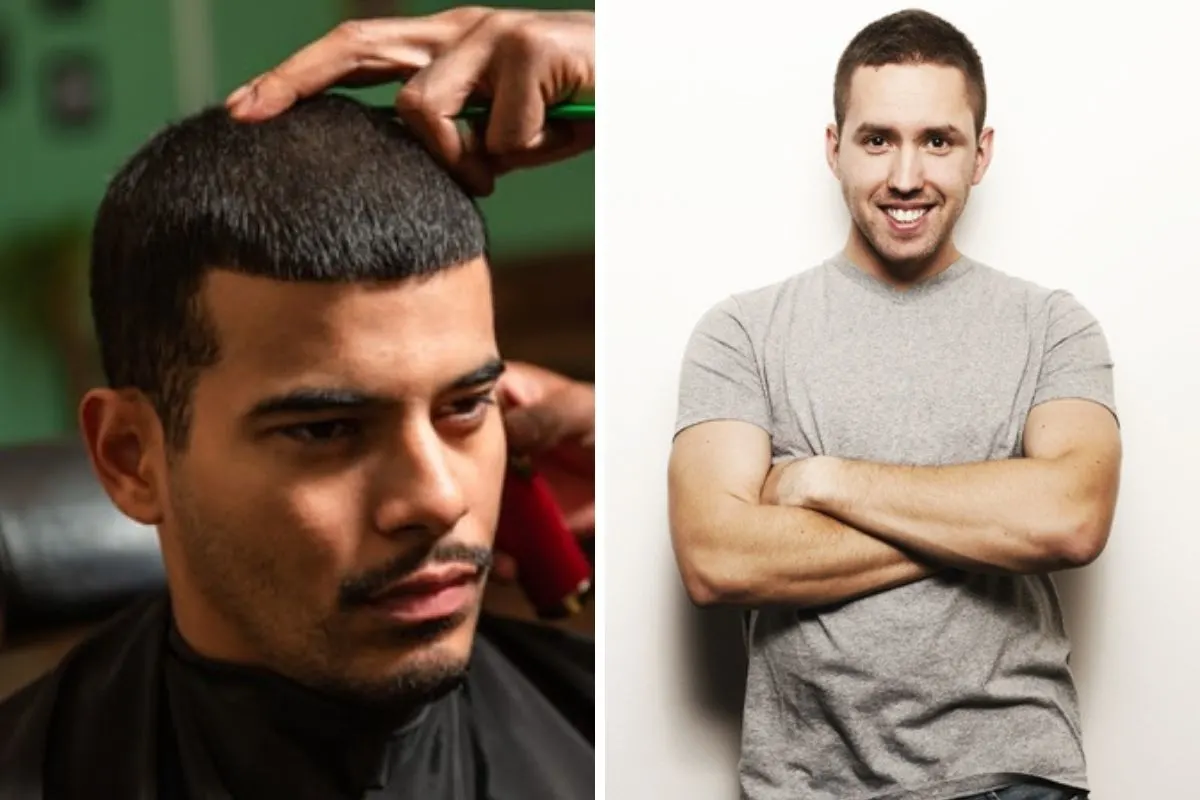
The left-hand image has a more sharply defined front edge; the right-hand image shows a different outline and angle. Guard length alone does not create that distinction. Discuss the finish at the hairline separately from how much hair to leave on top.
Examples With More Length On Top


Both pictures are better used to discuss the relationship between top and sides than an exact all-over setting. A longer attachment does not guarantee enough usable length for a quiff or a fringe: the direction and behavior of your hair still matter.
For a more detailed breakdown, see our #5, #6, #7 and #8 comparison, which also separates nominal lengths from unverified photo examples.
Why A Face-Shape Matrix Cannot Pick Your Guard
“Round,” “oval” and “square” can help describe the silhouette you want, but they do not determine a correct guard number. A little more height on top or less bulk at the sides changes the outline independently of the all-over length.
Instead of “What number suits a round face?”, ask “Do I prefer this with more top height, less side bulk, or neither?” Use front and side views. You do not need to change your face’s proportions to have a successful haircut.
For thinning or a changing hairline, see our buzz cut and receding hairline guide. A shorter cut is not guaranteed to conceal sparse areas and does not treat hair loss. A dermatologist can assess concerns about hair loss; a guard chart cannot.
Before Trying An All-Over Cut At Home
There is no mistake-proof home method. If you cannot see the back clearly or want a blended fade, a barber is a reasonable first step. You do not have to buy a premium machine simply to decide which length you like.
- Read your model’s instructions: confirm compatible guards, lever settings, cleaning and whether the appliance supports the intended dry or wet use.
- Check the equipment: use an intact, securely fitted attachment. Start longer than your intended final length.
- Make visibility a requirement: use good light and a second mirror or assistance for the back. Do not keep cutting an area you cannot see.
- Review before going shorter: check for missed areas and the overall shape. Do not compensate for every uneven-looking patch by repeatedly reducing the whole cut.
- Keep finishing conservative: removing the guard and cutting upward into the neckline is not a universal safe technique. Leave detailed edging to someone who can see and control it.
- Stop if there is a problem: do not keep passing a clipper over painful, irritated or broken skin. Follow the equipment’s safety instructions.
Do Not Tan Your Scalp To Match Your Face
A newly exposed scalp does not need to be “conditioned” by tanning. UV tanning damages skin. Use shade, a sun-protective hat and broad-spectrum, water-resistant SPF 30 or higher on exposed skin, following the label for application and reapplication. A spray is not automatically even coverage. The American Academy of Dermatology’s sunscreen guidance explains these precautions.
Choose your haircut for the look and upkeep you prefer. Do not rely on a seasonal guard-number rule as a substitute for sun protection or a suitable hat.
Keep A Next-Cut Record
Copy these prompts into your notes after the cut. This is a suggested personal comparison, not a test we have already performed.
- What was cut: date, top length, side length, attachment markings and relevant lever position.
- What changed: all-over shape, fade height, front outline or another single variable.
- How it looked: front, side and crown photographs in similar light with dry hair, if useful to you.
- How it fitted your routine: product needed, time spent arranging it and when you wanted a tidy-up.
- Next request: keep the specification, or name one change rather than just “shorter.”
Bottom line: start with enough length to keep your options open, specify the top and sides clearly, and record the result you actually prefer. That gives you a repeatable haircut instead of a guess based on somebody else’s photo.
Editorial note: Revised with AI assistance using the linked manufacturer and dermatology sources. The photos were visually reviewed as style references; no controlled haircut trial or clinical review was performed for this update. See how we evaluate recommendations.

Axel Lander is the founder and editor of ReadySleek. He publishes practical guides on men’s style, grooming, and fragrance, with a focus on clear comparisons, value, and the trade-offs readers should know before deciding.