Fades are great – they’re pretty simple for barbers to do and they can be included in pretty much any hairstyle you can think of. But what’s the difference between a mid fade and a high fade?
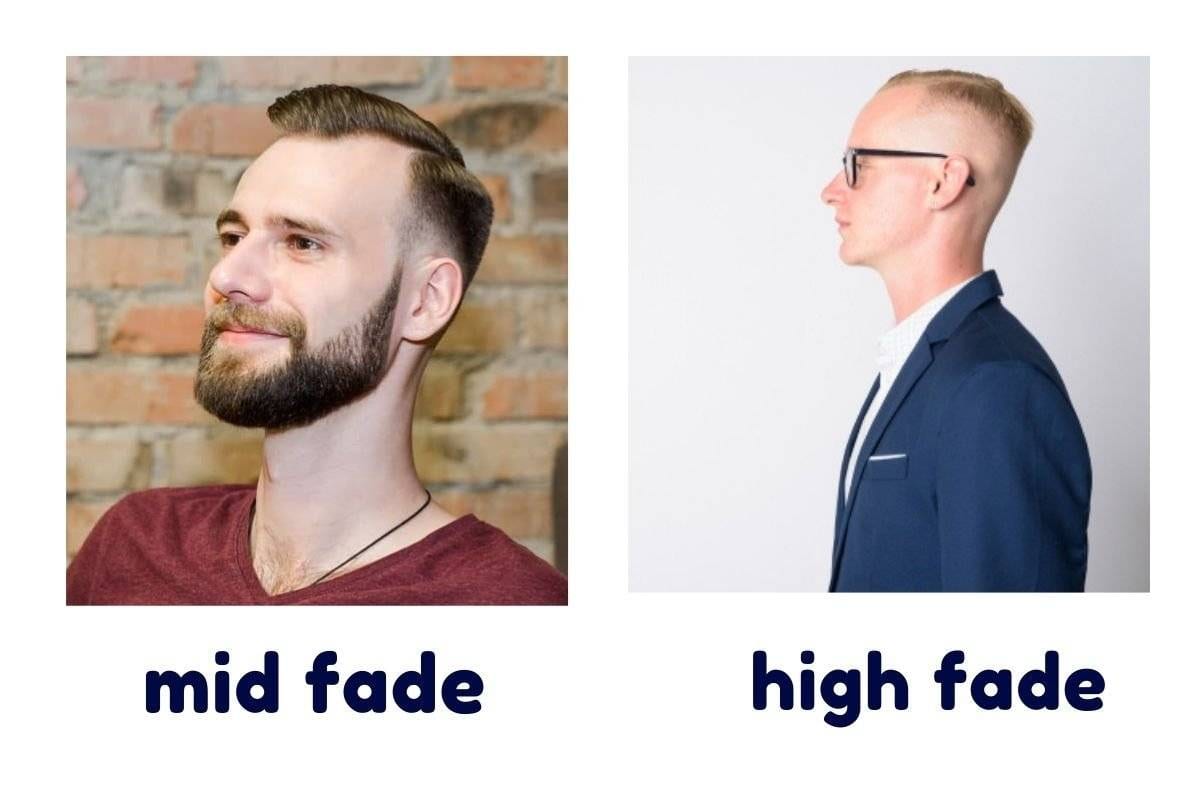
The difference between a mid fade and a high fade is where the fade starts to taper. With mid fades, the gradual tapering of length starts approximately an inch above the ear. In contrast, with high fades, this gradual tapering of length occurs around the level of the temples.
After talking about these differences in a little more detail, I’ll show you some photographs of both the mid fade and the high fade to really nail the point.
Then, we’ll talk through how you can choose which one is right for you.
Let’s get to it.
Want the height without clearing the whole side? That’s the high taper fade.
Mid Fade Vs High Fade: The Key Differences
The main differences between the mid fade and the high fade are the transition point and the subtlety.
1. Transition Point
The “transition point” of the fade is essentially where the “fade” starts.
It’s where the shortest length of the fade (at the bottom of the sides) gradually starts to increase in length.

Images from Deposit Photos and Shutterstock
The characteristic faded effect is a result of there being no harsh lines in between the different lengths.
Instead, the different lengths are seamlessly blended into one another through the use of fancy clipper techniques.
With a mid fade, this transition starts to occur around halfway up the sides. Although the exact height here will obviously depend on head size, on average, it’ll usually be around an inch above the top of the ear.
With a high fade, the transition occurs around the level of the temples. In other words, higher than a mid fade.
Although we aren’t going through low fades in much detail here, just know that with low fades the transition occurs around half an inch above the ear.
Essentially, “higher” fades have higher transition points.
But what does this mean in terms of how they actually look?
2. Subtlety
You could say that this difference is a direct consequence of the first one. The transition point of the fade has a huge impact on how subtle or not-so-subtle a fade can look.
Essentially, the higher up the fade is, the larger the total area of the sides (and back) clipped down to the shortest length of the fade.


(Deposit Photos)
In real terms, with mid fades, around half of the sides are at their shortest length. With high fades, most of the sides from the temples downward are at their shortest length.
This will, as you’d expect, make high fades a lot more obvious and attention-grabbing than mid fades.
High fades have a larger area of the sides trimmed super short than mid fades do.
The shorter this length is, the more eye-catching it’ll be as well.
For example, a skin fade has the shortest length shaved down to the skin before it gradually increases as you go upward.
Skin fades are as short as you can go – as a result, they stand out. The contrast between the longer hair on top and the shaved skin at the bottom is eye-catching, more so than a 1 fade or a 2 fade would be.
To sum that up, the higher the transition point of the fade, the less subtle it’ll be. But don’t forget that the shorter the fade is, the less subtle it’ll be as well.
Mid Fade Vs High Fade: Style Photos
Here are some examples of mid fades and high fades for some inspiration and to also help you choose.
Buzz Cut With Mid Fade
The buzz cut with a mid fade is a great option.


Induction-style buzz cuts have all of the hair trimmed down to the same, short, even length.
They’re easy to maintain and I’ve written pretty extensively about them on this site.
Adding a mid fade like this is a great way to make an otherwise straightforward buzz cut just a little more interesting.
Comb Over With Mid Fade
Comb overs may not be what you thought at first.


Yes, the term can also be used to refer to an awkward attempt at covering a balding scalp with a few long and wispy hairs.
But the proper use of the term actually refers to what’s shown in this photograph – hair gracefully slicked from one side to the other.
A mid fade is a great addition to one.
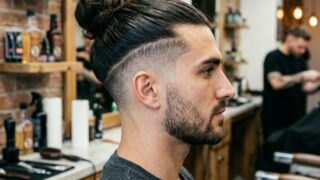
Man Bun With Mid Fade
Man buns and top knots can be pretty attention-grabbing in themselves.


But if you were really looking for a way to make them stand out, combining them with faded sides would be a good way to do it.
As you can see, the ultra-short sides give the man bun even more prominence.
Buzz Cut With High Fade
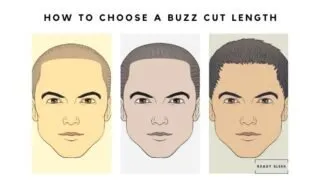
Here’s a buzz cut with a high fade.


It’s a good opportunity to compare it to the buzz cut with the mid fade earlier on.
As you can see, the transition point of the fade is higher up the sides. More specifically, it’s around the level of the temples.
As a result, more of the sides are clipped down to the shortest length with the high fade.
The buzz cut with a high fade is more eye-catching and obvious than the buzz cut with a mid fade.
When choosing between the two, you should really bear that in mind.
Faux Hawk With High Skin Fade
Faux hawks are actually more common than you might think – people just have trouble identifying them because the term isn’t as well known.


Faux hawks have a spiked or textured strip of hair running across the top of the scalp, just like its cousin the “mohawk” does.
However, the difference between the faux hawk and the mohawk is that the sides and back are gradually blended into the top with the fawk hawk.
With the mohawk, the transition from the sides/back to the top is a lot more sudden – like what you’d expect from an undercut.
The gradual blending from the sides/back to the top is the perfect opportunity to incorporate a high fade as you can see from this pic.
Slick Comb Over With High Fade
Here’s another comb over. The difference between this one and the previous one is that this one is slicker and the fade is higher.


It’s a good demonstration of just how bold a high fade can look when most of the sides and back are shaved and ultra-short.
How To Choose Between A Mid Fade And A High Fade
If the pictures weren’t enough to sway you in one direction over the other, consider these factors when making your decision between a mid fade and a high fade.
1. Attention
We’ve touched on this one already.
But just to really nail the point home, a high fade would get more attention than a mid fade would.
They may draw a few more comments or even a few stares. Don’t get me wrong – they’re not unusual by any means.
But overall, a high fade is more likely to become the focus of the hairstyle as opposed to just a feature than a mid fade would be.
2. Face Shape
The higher the fade, the more of the sides and back are trimmed down to the shortest length.
As a result, high fades can remove quite a lot of fullness from the sides – even more so than a mid fade would.
High fades can actually have a narrowing and slimming effect on the face – a good option for men with rounder face shapes.
Mid fades do this too, but less so than high fades. You’ll retain more fullness at the sides with a mid fade.
Because of this, mid fades would probably be a better option for men with longer face shapes or overpowering features at the chin. Having just a little more hair at the sides can produce just enough fullness to soften the aesthetic.
3. Maintenance
Fades require maintenance. What’s more, is that it isn’t usually the kind of maintenance you can do yourself.
DIY fades don’t usually end up well unless you’ve got some unusual skills with a pair of clippers.
Ultimately, a fade touch-up should be done by a barber.
Visits to a barber can add up – both in terms of time and money.
In general, the higher the fade and the shorter the fade, the more touch-ups required.
Mid fades aren’t that much easier to maintain than high fades are, but there is usually a difference.
It’s important to bear this in mind.
4. Receding Hairline
The final factor to consider when choosing between a mid fade and high fade is whether or not you’ve got a receding hairline.
A cool benefit of high fades is the way in which the fade can almost absorb the receding hairline at the temples.
It’s almost like the receding area at the temples just gets swallowed up by the high fade. As a result, the receding hairline looks a little less obvious.
Mid fades aren’t quite high enough to give you this benefit.
This one won’t be relevant to everyone. But if you’ve got a receding hairline, a high fade may be a good way to style it out.
Frequently Asked Questions
Here are a couple of FAQs on the topic to really round things up.
Mid Skin Fade Vs High Skin Fade: What’s The Difference?
A mid skin fade has the shortest length of the fade shaved down to the skin before gradually increasing in length around an inch above the ear. In contrast, a high skin fade will have the shaved area start to increase in length around the level of the temples.
The differences between mid skin fades and high skin fades are exactly the same as they would be for mid fades and high fades of other lengths.
You should consider the same factors listed above when choosing between them.
One thing to note is that skin fades typically look bolder and more striking, simply because the shortest length of the fade (before it starts to transition) is shaved all the way down.
High skin fades are very striking, simply because most of the sides and back will be shaved. Mid skin fades are also pretty attention-grabbing but not quite as much as a high skin fade.
Mid Taper Fade Vs High Taper Fade: What’s The Difference?
“Mid taper fades” and “high taper fades” are essentially the same as “mid fades” and “high fades”.
It’s best not to use the terms, as they can be confusing.
A “taper” is technically a very low fade that doesn’t extend above the top of the sideburn. However, the term is also sometimes used (incorrectly) to refer to fades in general – even low, mid, and high fades.
Overall, it’s best to avoid using the term “taper fade” and simply refer to them as “fades”.
Conclusion
There you have it.
The differences between a mid fade and a high fade laid out in (hopefully) a clear and structured way.
If you were on the fence about one or the other, you should now have a better idea of which one is for you.
Enjoy.
Where Exactly Does Each Fade Start? (Visual Guide)
The biggest confusion with fades is understanding exactly where each one begins. Here’s the definitive placement guide:
| Fade Type | Starting Point | Anatomical Landmark | % of Side Hair Removed |
|---|---|---|---|
| Low Fade | Just above the ears | Where the ear meets the head | ~20–30% |
| Mid Fade | At the temples | Corner of the eye level, halfway up the head | ~50% |
| High Fade | Above the temples | Above the parietal ridge (widest point of skull) | ~70–80% |
| Skin/Bald Fade | Can be any height | Fades to zero/skin at the bottom | Varies by height |
What to Tell Your Barber (Exact Terminology)
Barbers hear “I want a fade” dozens of times daily, and every client means something different. Here’s how to be specific:
For a Mid Fade: “I’d like a mid fade that starts at the temple line. Blend it up to a [#2/#3/#4] on the sides, and keep [X inches/the current length] on top. I want it [skin/zero at the bottom OR a #1 at the bottom].”
For a High Fade: “High fade starting above the parietal ridge. Take it down to [skin/zero OR #0.5/#1] at the bottom, and blend into [X] on top. I want the transition [tight/gradual].”
Key modifier words:
- “Tight fade” = short transition zone, dramatic contrast
- “Gradual fade” = longer transition zone, smoother blend
- “Shadow fade” = never goes completely to skin — shortest point is a #0.5
Maintenance Comparison: Mid Fade vs High Fade
| Factor | Mid Fade | High Fade |
|---|---|---|
| Time between barber visits | 3–4 weeks | 2–3 weeks |
| Grows out gracefully? | Yes — still looks good at 4+ weeks | No — loses shape after 2.5 weeks |
| DIY touch-up possible? | Moderate difficulty | Hard — the high line is difficult to self-maintain |
| Annual barber cost (@ $30/visit) | ~$390–$520 (13–17 visits) | ~$520–$780 (17–26 visits) |
| Best for lazy grooming? | 🏆 Yes | No — requires consistent upkeep |

Axel Lander is the founder and editor of ReadySleek. He publishes practical guides on men’s style, grooming, and fragrance, with a focus on clear comparisons, value, and the trade-offs readers should know before deciding.