📖 This guide is part of our complete Shirt & Pants Color Combinations collection — browse all combinations in one place.
White, light blue, pale pink and navy are the safest shirts for grey pants. Which one looks best depends on how dark your grey is: light grey pants need a darker or more colorful shirt to stand out, while charcoal pants look sharpest with a light shirt. For the office, start with white or light blue; for evenings and smart-casual plans, try navy, burgundy or a muted green.
Most advice stops at “grey goes with everything”. That is true in the sense that grey rarely clashes. It is not true in the sense that every shirt looks equally good. A white shirt over light grey trousers is a quiet, low-contrast outfit. The same white shirt over charcoal is about as crisp as menswear gets. The chart below shows that difference as a number, so you can decide how much contrast you actually want.
Shirt Color Chart For Light Grey, Mid Grey And Charcoal Pants
Each cell shows the light–dark contrast between the shirt and the pants, calculated from the example colors in the swatches. 1.0 means both are equally light; higher numbers mean a stronger split between top and bottom. The label after the number is our own shorthand: tonal (under 1.5), soft (1.5–3), clear (3–7) and strong (7 and above). How we built the chart explains the method and its limits.
| Shirt | Light grey pants | Mid grey pants | Charcoal pants | Where it works best |
|---|---|---|---|---|
| White | 1.7 soft | 4.0 clear | 9.9 strong | Any grey; sharpest with charcoal. Formal, interviews, office. |
| Light blue | 1.1 tonal | 2.6 soft | 6.5 clear | Office and business casual, all year. |
| Pale pink | 1.0 tonal | 2.3 soft | 5.8 clear | Business casual, spring and summer events. |
| Lavender | 1.1 tonal | 2.7 soft | 6.8 clear | An alternative to pink; best on mid grey or charcoal. |
| Sage green | 1.4 tonal | 1.7 soft | 4.2 clear | Smart casual, daytime; strongest on charcoal. |
| Mid blue | 2.7 soft | 1.1 tonal | 2.2 soft | Light grey; on mid grey the hue does the work. |
| Olive | 3.6 clear | 1.5 soft | 1.7 soft | Light grey chinos, weekends. |
| Burgundy | 7.2 strong | 3.1 clear | 1.2 tonal | Evenings, fall and winter; best on light or mid grey. |
| Navy | 8.3 strong | 3.5 clear | 1.4 tonal | Smart casual, dinners, dates; best on light or mid grey. |
| Black | 11.3 strong | 4.8 clear | 1.9 soft | Evenings only; light or mid grey, not charcoal. |
| Light grey | 1.0 tonal | 2.4 soft | 5.9 clear | Charcoal pants; avoid the same shade top and bottom. |
Pro tip: Read across a row, not just down a column. White is “strong” on charcoal but only “soft” on light grey. Navy is the reverse. Neither shirt is better in general — each one is better for a particular pair of trousers.
Why “White Goes With Everything” Is Only Half True
Grey is a neutral, so it does not fight with colors the way, say, a green pant and a red shirt can. What grey does do is set a level of lightness. Your shirt then either sits close to that level (a calm, tonal look) or far away from it (a crisp, high-contrast look).
That is why the same shirt can feel different on two pairs of grey pants:
- White on light grey (1.7) reads as one pale block. It works in summer and with linen, but it will not look as sharp as you might expect.
- White on charcoal (9.9) is the classic dark-bottom, light-top split you see with suits. It looks deliberate and formal.
- Navy on charcoal (1.4) nearly merges. From a few feet away, the outfit can look like one dark mass.
- Navy on light grey (8.3) is one of the strongest pairings in the chart, which is why it works so well for evenings and dinners.
Low contrast is not a mistake. Light blue or pale pink on light grey pants (around 1.0–1.1) still works because the colors differ, even though the lightness barely does. It is simply a softer outfit. If you want to look crisp, move further apart on the chart; if you want something relaxed, stay close.
One more effect is worth knowing. Grey tends to pick up a faint tint opposite to the color next to it — grey beside green can look slightly warmer, grey beside red slightly cooler. Perception researchers call this simultaneous or color contrast. It is subtle on clothing, but it explains why the same grey trousers can look “warmer” with a sage shirt than with a pink one.
Best Shirts For Each Shade Of Grey Pants
Light grey pants
Light grey (sometimes sold as dove, pearl or silver grey) is the shade where most “white shirt” advice falls short. White, light blue and pink all sit close to it, so the outfit looks soft. That is perfect for a summer wedding or a linen look. For more definition, choose a darker or richer shirt: navy, burgundy, mid blue or olive.
- Crisp: navy, burgundy, black (evening only)
- Relaxed: white, light blue, pale pink, sage
- Casual: olive, mid blue, denim-blue chambray

Mid grey pants
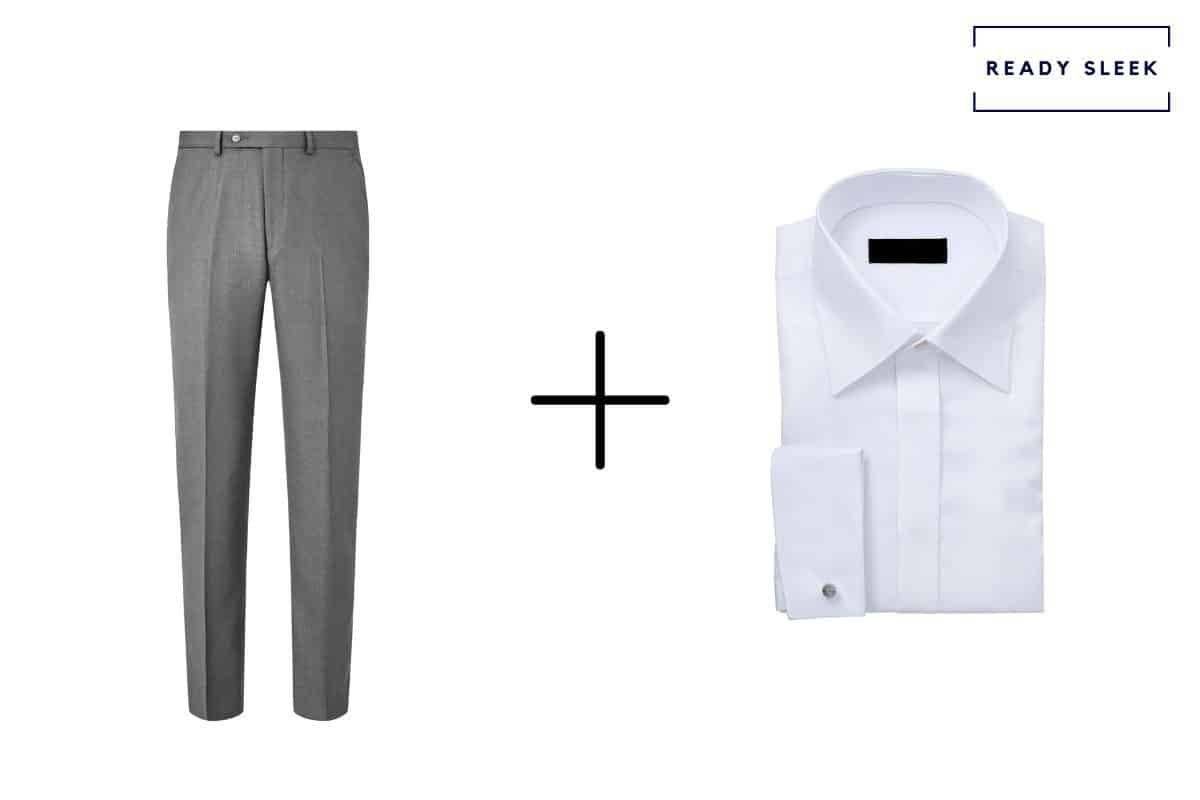
Mid grey (often called medium, slate or heather grey) is the most forgiving shade. Almost every shirt in the chart lands in the soft-to-clear range, so you can lean on color rather than contrast. White and light blue look neat for work; navy, burgundy and black give a clear split for evenings. The only shirts that blur into mid grey are those with a similar lightness, such as a mid blue or a grey shirt.



Charcoal and dark grey pants
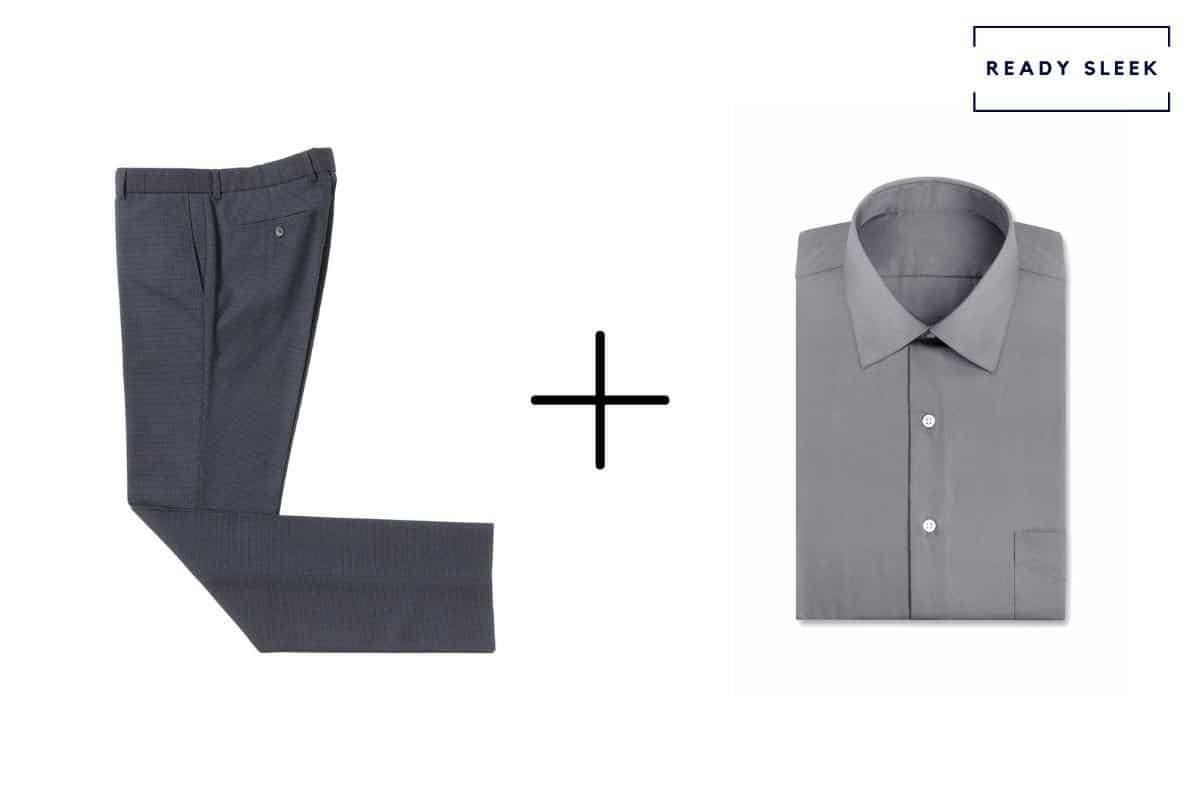
Charcoal behaves almost like navy or black trousers. Light shirts look sharp on it: white, light blue, pink, lavender and a light grey shirt. Dark shirts are the problem. Navy and burgundy drop into the “tonal” range and black only reaches 1.9, so the outfit loses its outline. If you want a dark shirt with charcoal, pick one with visible texture or a pattern, or add a lighter jacket.


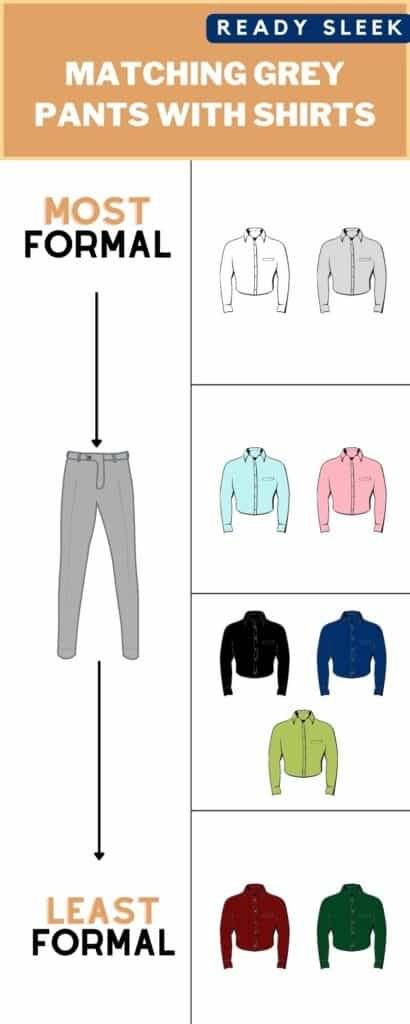
Best Shirt Colors With Grey Pants By Occasion
Dress codes are fuzzier than most guides admit. Even “business casual” has no single agreed definition, so check what your workplace or invitation actually means. The definitions below are our working versions.
| Occasion | What it usually means | First choice | Also good |
|---|---|---|---|
| Interview, formal office | Tailored grey trousers or a suit, tie possible | White on mid grey or charcoal | Light blue |
| Business casual | Dress pants or smart chinos, collared shirt, often no tie | Light blue | White, pale pink, lavender, subtle stripes |
| Wedding guest (daytime) | Suit or trousers and jacket, lighter colors welcome | White or pale pink on light/mid grey | Light blue, lavender |
| Dinner, date, evening event | Smart casual, darker colors are fine | Navy or burgundy on light/mid grey | Black on light or mid grey |
| Weekend, casual | Chinos, polos, oxfords, overshirts | Olive or sage | Chambray, white oxford, rust or mustard in small doses |


Grey Dress Pants, Chinos, Flannel Or Linen: Match The Shirt Fabric
Color is only half the match. The shirt should also sit at the same level of formality as the trousers:
- Grey dress pants (smooth wool): a smooth dress shirt — poplin or twill — in white, light blue or a quiet stripe. A rough oxford looks underdressed here.
- Grey flannel trousers: the soft, fuzzy surface pairs well with oxford cloth, brushed cotton and knitwear. Burgundy, navy and light blue all look at home.
- Grey chinos: oxford shirts, chambray, polos and casual colors such as olive and sage. Save the formal white poplin for dress pants.
- Grey linen trousers: linen or light cotton shirts in white, light blue or pink. Expect wrinkles and lean into the relaxed look.
- Grey jeans: treat them like casual chinos. Plain tees, flannel shirts and denim-blue shirts work better than dress shirts.
Not sure whether your trousers count as chinos or dress pants? Our chinos vs. pants vs. trousers guide explains the difference.
Shoes And Belt With Grey Pants
The simple rule: match your belt to your shoes, and let the formality of the outfit choose the color.
- Black shoes: the formal choice, especially with charcoal and in the evening.
- Dark brown or burgundy shoes: work with every shade of grey and suit business casual well.
- Tan or light brown shoes and suede: best with light and mid grey for daytime and casual outfits. With charcoal they can look too casual.
- White sneakers: fine with grey chinos or jeans, not with formal dress pants.
For grey suits specifically, see what color shoes go with a grey suit and what color belt goes with a grey suit.
Patterned Shirts With Grey Pants
Grey trousers are usually plain, which makes them an easy base for a patterned shirt. Three rules keep it tidy:
- Use the chart for the background color. A blue gingham on charcoal behaves like a light blue shirt; a navy check on light grey behaves like a navy shirt.
- One pattern at a time. If your trousers have a visible check or pinstripe, keep the shirt plain or choose a pattern of clearly different scale.
- Finer patterns look more formal. Thin stripes and small checks suit the office; bold checks and large plaids belong with chinos and jeans.


Grey Pants And Shirt Combinations To Skip
- Black shirt with charcoal pants. At 1.9 the two read as one dark block, and the outfit can look heavy. Choose black with light or mid grey instead.
- Navy or burgundy with charcoal, without anything else. Both land in the tonal range. Add a lighter jacket or knit, or swap the trousers for a lighter grey.
- A shirt in the same grey as your pants. Matching grey top and bottom looks like a mismatched suit. Grey on grey works when the shades are clearly apart — a light grey shirt with charcoal trousers, for example.
- Black shirt in a daytime office. It can look like evening wear. Keep it for dinners and events.
- Neon or very saturated shirts. They overpower grey and pull all attention to the top half. Muted versions (dusty pink instead of hot pink, sage instead of lime) are easier to wear.


Wearing A Grey Shirt Instead?
If the grey piece is your shirt rather than your trousers, the logic flips: dark trousers such as navy, charcoal or black usually work best with a light grey shirt, and lighter trousers with a darker grey shirt. We cover that case in detail in what color pants go with a grey shirt.


How We Built The Chart
Method. We picked one example color for each shirt and for three grey trousers (light #C8C8C8, mid #808080, charcoal #36454F). For each pair we calculated the relative luminance and the contrast ratio with the formula published by the W3C for web accessibility (relative luminance, contrast = (lighter + 0.05) / (darker + 0.05), as defined in WCAG 2.1).
Limits. These are example colors, not measured fabrics. Your “light blue” or “charcoal” may be lighter or darker, and texture, sheen and lighting all change the result. The formula was designed for text on screens; we use it only as a transparent way to compare light and dark. It ignores hue, which is why some “tonal” pairings still look good. The labels tonal, soft, clear and strong, and the occasion advice, are our own editorial judgment, not a test result.
What we left out. Many guides match shirt colors to skin tone or “color seasons”. We did not, because seasonal color analysis has not been scientifically tested and the guides we checked contradict each other. A practical alternative: hold the shirt next to your face in daylight and keep the one that does not wash you out.
A note on spelling: “grey” and “gray” are the same color. Americans mostly write gray, British English uses grey, and everything in this guide applies to both.

Axel Lander is the founder and editor of ReadySleek. He publishes practical guides on men’s style, grooming, and fragrance, with a focus on clear comparisons, value, and the trade-offs readers should know before deciding.