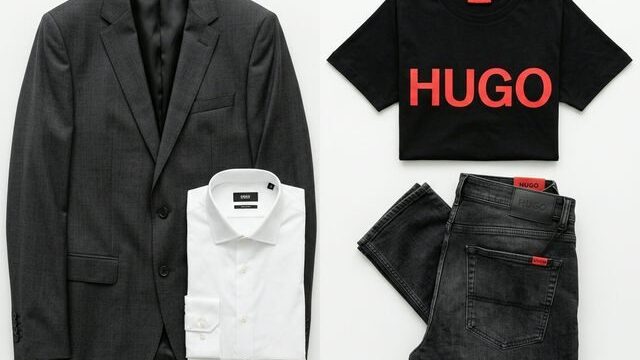
BOSS and HUGO are separate brands owned by HUGO BOSS AG. BOSS centres on modern tailoring, smart casualwear, and a broader 24/7 wardrobe. HUGO is the more contemporary, unconventional, and streetwear-influenced option. The practical difference is design direction—not a blanket rule that every BOSS garment is better made than every HUGO garment.
The Short Answer
| Choose | If you mainly want | Inspect carefully |
|---|---|---|
| BOSS | Modern tailoring, office-to-weekend versatility, restrained styling | Fabric composition, construction, and fit still vary by garment |
| HUGO | Contemporary tailoring, bolder details, streetwear influence, a more fashion-led look | Do not buy it only because you expect it to be a “cheap BOSS” |
If both brands make the item you need, compare the two garments directly. The label tells you the design lane; the care label, seams, fit, and return terms tell you more about the individual purchase.
Side-by-Side Comparison
| Feature | BOSS | HUGO |
|---|---|---|
| Official positioning | 24/7 lifestyle brand | Contemporary, unconventional brand |
| Core look | Modern tailoring and smart casualwear | Contemporary tailoring and streetwear-influenced pieces |
| Typical visual effect | More restrained and versatile | More directional and expressive |
| Current brand structure | Black, Camel, Orange, and Green lines | Seasonal HUGO range, including contemporary and denim-led options |
| Quality claim you can make safely | HUGO BOSS says both brands share high standards for quality, innovation, and sustainability | |
| Best buying test | Compare the specific item’s material, construction, fit, care requirements, price, and return policy | |
What The Company Itself Says
The HUGO BOSS 2025 Annual Report describes BOSS as a 24/7 lifestyle brand. BOSS Black focuses on modern tailoring and smart casualwear; BOSS Camel on higher-end menswear tailoring; BOSS Orange on casualwear; and BOSS Green on athleisure.
The same report describes HUGO as contemporary and streetwear-influenced, with an authentic, unconventional style. Importantly, it also says the two brands share high standards for quality, innovation, and sustainability. That contradicts the oversimplified shopping advice that BOSS is automatically “good quality” and HUGO automatically uses inferior materials.
Source method: brand-positioning statements here were checked against the company’s current corporate site and 2025 Annual Report on August 26, 2026. Product ranges can change, so use the official store for the current assortment.
Does BOSS Have Better Quality Than HUGO?
Not as a universal rule. BOSS may offer more tailoring-led or higher-priced options in parts of its range, but the label alone does not prove the material or construction of a specific garment. HUGO BOSS explicitly presents BOSS and HUGO as sharing the same high standards.
For a useful comparison, inspect:
- Fabric composition: compare fibre percentages instead of assuming wool, cotton, or synthetics from the brand name.
- Construction: check lining, seam finishing, pattern alignment, buttons, zips, and how the garment holds its shape.
- Fit: a less expensive garment that fits well usually looks better than a costlier one that needs major alteration.
- Care: dry-clean-only tailoring can cost more over time than a washable casual item.
- Price at the time of purchase: compare equivalent categories and account for sales; static price bands age quickly.
Style And Design
BOSS is the safer starting point when you want a suit, polished separates, restrained knitwear, or casual pieces that can move between work and weekends. “Classic” does not mean old-fashioned: the company frames BOSS as modern tailoring and a 24/7 lifestyle brand.
HUGO is the clearer fit when you want a more fashion-led silhouette, bolder styling, or streetwear influence. It also covers contemporary tailoring, so it should not be reduced to casual clothing or assigned to a rigid age group.
Which Should You Buy?
Choose BOSS when:
- You want one item to work across office, event, and smart-casual settings.
- You prefer restrained branding and modern tailoring.
- A BOSS line serves the use case: Black for the broad tailored/smart-casual range, Camel for elevated menswear tailoring, Orange for casualwear, or Green for athleisure.
Choose HUGO when:
- You want a more contemporary or unconventional design.
- You prefer streetwear influence, bolder details, or a fashion-led silhouette.
- The HUGO garment fits and is made better for your needs than the BOSS alternative.
Best value rule: compare like with like. A discounted HUGO T-shirt and a BOSS tailored jacket do not reveal a meaningful brand-wide price or quality gap.
Frequently Asked Questions
Is BOSS the same as Hugo Boss?
BOSS is one of the two main brands operated by HUGO BOSS AG; HUGO is the other. “Hugo Boss” is the company name, while BOSS and HUGO are the consumer-facing brand labels.
Is BOSS better quality than HUGO?
You cannot determine that from the label alone. The company says both brands share high quality standards. Compare the material, construction, fit, care requirements, and price of the exact garments.
Is HUGO only for younger shoppers?
No fixed age rule is useful. HUGO has a more contemporary and unconventional design direction, but the better test is whether the cut, styling, and use case suit you.

Axel Lander is the founder and editor of ReadySleek. He publishes practical guides on men’s style, grooming, and fragrance, with a focus on clear comparisons, value, and the trade-offs readers should know before deciding.