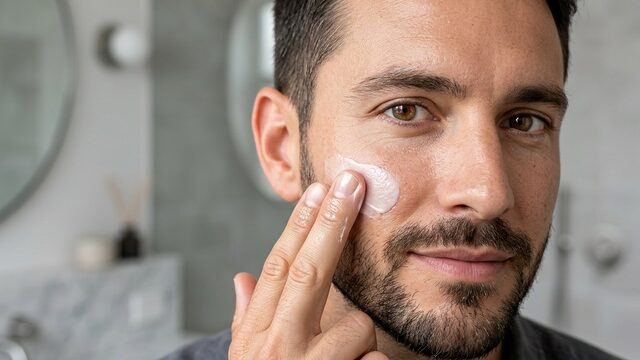
The two anti-aging products with the strongest backing are boring: a broad-spectrum sunscreen and a moisturizer. The American Academy of Dermatology (AAD) says dermatologists agree these are the two most effective anti-aging products you can buy. Everything else, retinoids included, comes after them, one product at a time, and takes weeks to show anything (see the one-at-a-time rule).
How this guide was put together: we built it from AAD patient guidance on anti-aging products, retinoids and sun protection, and from the makers’ own product pages (active ingredients, sizes, list prices, directions), all checked on October 18, 2026. No dermatologist reviewed this page and we did not run our own skin trials. It is an editorial guide, not a medical review and not personal advice.
Start Here: Sunscreen and Moisturizer
Sunscreen. The AAD names the sun as a major cause of premature skin aging and recommends a broad-spectrum, water-resistant sunscreen with SPF 30 or higher every day on all skin that clothing doesn’t cover. Its sunscreen FAQ points to a randomized trial (Hughes et al.) on sunscreen and the prevention of skin aging. Sources: AAD, 11 ways to reduce premature skin aging; AAD, Sunscreen FAQs.
Moisturizer. Moisturizer traps water in the skin. The AAD says that can plump up fine lines within a few days and make skin look brighter. It is the only product on this page that works that fast, and the effect lasts only as long as you keep using it.
At the guideline dose, a face sunscreen runs out faster than most people expect. Our sunscreen math does the numbers. For choosing a formula, see the SPF guide for men.
The One-at-a-Time Rule (and the Timeline It Implies)
The AAD’s advice for anti-aging products comes down to three rules. First, give sunscreen and moisturizer a few weeks, then pick your one biggest concern, such as wrinkles or dark spots. Second, add one product at a time, because using more than one anti-aging product within a few days or weeks can irritate the skin, and irritated skin looks older. Third, wait: most products take at least six weeks to work, and some take three months. Sources: AAD, How to select anti-aging skin care products; AAD, How to maximize results.
Put those rules on a calendar and the honest timeline is longer than most product pages suggest:
| Phase | What you add | When you can judge it |
|---|---|---|
| 1. Base | Daily sunscreen and moisturizer | After a few weeks (moisturizer: fine lines can look plumper within days) |
| 2. First active | One product for your biggest concern, e.g. a retinoid for fine lines | 6 weeks to 3 months after you start it |
| 3. Second active (optional) | One more product, only if phase 2 is tolerated and a concern remains | Another 6 weeks to 3 months |
Two more AAD tips belong here. Test a new product on your inner forearm twice a day for four to five days before it goes on your face, even if it says “hypoallergenic”. And stop a product that stings, burns or tingles, unless a dermatologist prescribed it and told you to expect that.
Retinoids: The Usual First Active
Retinoids are vitamin A derivatives. According to the AAD, they speed up the turnover of surface skin cells and boost collagen, which improves skin tone and reduces fine lines and wrinkles. Retinol is the type sold over the counter for uneven tone, pigmentation and texture. Tretinoin is prescription only. Source: AAD, Retinoid or retinol?
Three practical points from the same AAD article and the makers’ directions:
- Start with the mildest formula, every other night. That is what the dermatologist quoted by the AAD tells patients who want to start right away with tretinoin.
- The percentage is often missing. For over-the-counter products, there is no standard requirement to disclose the retinol percentage on the label, the AAD notes. You can see this in the table below: one of the two retinoids states its strength, the other doesn’t.
- Nights only, sunscreen in the morning. The Ordinary says its Retinal 0.2% can increase sun sensitivity, recommends it for evening use only, and tells users to start once a week, build to twice a week as tolerated, and not combine it with other retinoids.
What You Pay per Milliliter, and What the Label Tells You
The AAD says effective anti-aging products come in all price ranges. To make that concrete, we put the makers’ list prices next to their stated sizes and active ingredients. Compare prices within a category only, because you use a few drops of a serum but a full teaspoon of sunscreen.
| Product | Active ingredient (maker’s page) | Strength stated? | Size and list price | Price per unit |
|---|---|---|---|---|
| The Ordinary Retinal 0.2% Emulsion | Retinaldehyde (retinal) | Yes, 0.2% | 15 ml, $14.90 | $0.99 per ml |
| CeraVe Resurfacing Retinol Serum | Encapsulated retinol, plus niacinamide and ceramides | No retinol percentage given | 1 fl oz, $21.99 | $0.74 per ml |
| EltaMD UV Clear SPF 46 | 9.0% zinc oxide, 7.5% octinoxate | Yes | 1.7 oz, $46 | $27.06 per oz (about $0.92 per ml) |
| CeraVe AM Facial Moisturizing Lotion SPF 30 | Broad-spectrum SPF 30 sunscreen in a moisturizer | SPF on the label | 2 fl oz, $19.99 | $10.00 per fl oz (about $0.34 per ml) |
| CeraVe PM Facial Moisturizing Lotion | Niacinamide, hyaluronic acid, ceramides | No percentages given | $19.99 (several sizes listed) | Not calculated: the page doesn’t tie the price to one size |
| Paula’s Choice 2% BHA Liquid Exfoliant | Salicylic acid | Yes, 2% | $37 (size not shown with the price) | Not calculated |
What the table shows: the cheaper retinoid per milliliter is the one that doesn’t tell you its strength. That doesn’t make it worse. It does mean you cannot compare the two on dose, only on price and on how your skin tolerates them. Paula’s Choice calls its BHA an exfoliant that unclogs pores and controls oil. Treat it as an add-on for clogged pores and rough texture, not as a wrinkle treatment.
The Short List
These are examples for each phase in the timeline, not ranked winners. We picked them because the maker publishes the active ingredients and the directions, and because they are widely available. Links go to Amazon search results.
- Base, sunscreen: EltaMD UV Clear SPF 46 (zinc oxide plus octinoxate) or the cheaper CeraVe AM Facial Moisturizing Lotion SPF 30, which combines moisturizer and sunscreen for the morning.
- Base, night moisturizer: CeraVe PM Facial Moisturizing Lotion. How it compares with Cetaphil’s line: CeraVe vs. Cetaphil.
- First active, gentler start: CeraVe Resurfacing Retinol Serum. CeraVe says the retinol is encapsulated and markets the serum for post-acne marks, pores and texture.
- First active, stated strength: The Ordinary Retinal 0.2% Emulsion. The maker calls it its highest-strength retinoid formula, aimed at advanced signs of aging. Given the AAD’s “mildest first” advice, it isn’t the obvious first retinoid for someone who has never used one.
- Optional, for clogged pores: Paula’s Choice 2% BHA Liquid Exfoliant. It counts as an active, so the one-at-a-time rule applies.
Claims We Removed, and Why
An earlier version of this page made claims we could not trace to a source when we rechecked it. Here is what changed:
| Earlier claim | What we found |
|---|---|
| “Dermatologist-backed picks” | No dermatologist reviewed or selected these products. The AAD does not endorse products. Removed. |
| “UV exposure causes 80–90% of visible facial aging” | The AAD says the sun plays a major role in premature skin aging. We could not verify the percentage in a source we could access, so we dropped it. |
| A vitamin C serum “enhances sunscreen effectiveness by up to 8x” | Not verified. We also could not open the maker’s product page to check its formula, so the vitamin C pick is gone (see what we left out). |
| Retinal shows results “in 4–6 weeks vs. 8–12 weeks” for retinol | No source found for that comparison. The AAD’s general figure is at least six weeks, sometimes three months. |
| Hyaluronic acid “holds up to 1,000x its weight in water” | Not verified for a skin product. Removed, together with the product pick. |
| Expensive products are the exception for some actives | The AAD’s point is the opposite: effective products come in all price ranges. |
One AAD point to keep in mind on any label: “clinically proven” means the product was given to consumers to try. It does not mean it went through clinical trials or was approved by the U.S. Food and Drug Administration (FDA). Promises like “look 10 years younger” are, in the AAD’s words, too good to be true. Anti-aging products deliver modest results.
What We Left Out
- Vitamin C serums. They are popular, but the manufacturer page for the serum we used to list blocked our access, and the AAD pages we used don’t rank vitamin C. We’d rather leave the slot empty than repeat claims we can’t check.
- Eye creams. We found no AAD guidance that singles them out as an anti-aging step, so the old pick is gone. Sunscreen and moisturizer go up to the eye area too.
- A full routine. Cleanser and basics are covered in our men’s skincare routine.
Habits That Count as Much as Products
From the AAD’s list of ways to reduce premature skin aging: don’t tan, from the sun or a tanning bed, because every tan ages the skin. If you smoke, stop, because smoking greatly speeds up skin aging and causes wrinkles and a dull complexion. Sunglasses help with squint lines. Wear sun-protective clothing and a wide-brimmed hat when you’re outside for long.
When to See a Dermatologist
The AAD suggests seeing a board-certified dermatologist if you’ve followed these steps and still don’t see the results you want. A dermatologist can also prescribe stronger retinoids such as tretinoin and explain treatments a cream can’t match. In the AAD’s words, you cannot get the results of a facelift from a cream. A new or changing spot is not an anti-aging question. Have it checked by a dermatologist.
FAQ
What is the single best anti-aging product for men?
A broad-spectrum sunscreen with SPF 30 or higher, used every day in the right amount. The AAD names sunscreen and moisturizer as the two most effective anti-aging products.
How long until an anti-aging product works?
A moisturizer can plump fine lines within days. According to the AAD, most other products need at least six weeks and sometimes three months. Keep using a product if you want to keep the results.
Is retinal stronger than retinol?
The Ordinary calls its Retinal 0.2% its highest-strength retinoid formula. Since many retinol products don’t state their percentage, a direct dose comparison is often impossible. The AAD-quoted advice is to start with the least intense formula.
Can I use a retinoid and an exfoliant at the same time?
Not when you start. The AAD warns that using more than one anti-aging product within a few days or weeks can irritate the skin. Add one, wait, then decide on the next. The Ordinary also advises against combining its retinal with other retinoids.
Do expensive anti-aging products work better?
Not reliably. The AAD says effective products come in all price ranges, and the price table shows how little the price says about what’s inside.
This guide is general information, not medical advice. If you’re pregnant, have a skin condition or react to a product, talk to a board-certified dermatologist or your doctor before using retinoids or other actives.

Axel Lander is the founder and editor of ReadySleek. He publishes practical guides on men’s style, grooming, and fragrance, with a focus on clear comparisons, value, and the trade-offs readers should know before deciding.