
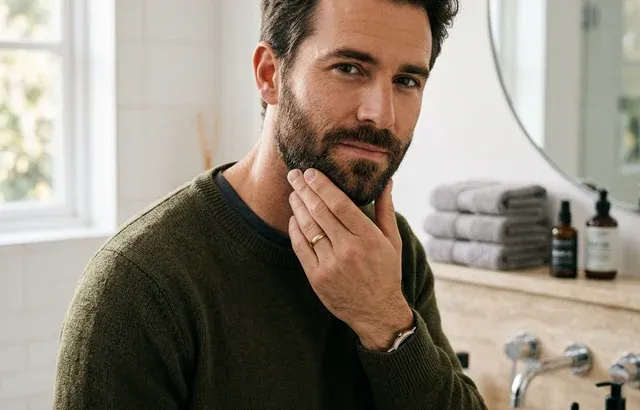
The 3-week beard might be the most underrated phase of beard growth. You’re past the initial stubble
stage, but you’re not quite at a full short beard yet. At roughly 9–10mm of growth, your face is in the awkward
in-between zone where many men give up.
This article contains affiliate links. If you purchase through our links, we may earn a small commission at no extra cost to you. This helps support Ready Sleek.
Don’t. This guide covers exactly what to expect at 3 weeks, how to handle the itch, whether your patchiness is
normal, and what to do (and not do) to set yourself up for a great beard.
How Long Is a 3-Week Beard?
At 3 weeks (21 days), most men will have approximately 8–10mm (roughly ⅜ inch) of facial hair
growth. This places you right at the Number 3 guard length
— the boundary between heavy stubble and a proper short beard.
However, growth rates vary significantly. Factors include:
- Genetics — the single biggest factor in growth rate and density
- Age — beard growth typically peaks between ages 25–35
- Hormones — testosterone and DHT levels directly influence thickness
- Health & nutrition — diet, sleep, and stress all play a role
If your growth is slightly shorter or longer than 10mm, that’s completely normal. Some men’s beards grow closer to
6mm in 3 weeks, while others may hit 12mm+.
What Does a 3-Week Beard Look Like?
At this stage, your beard is starting to look intentional rather than neglected. Here’s what’s typical:
- Uneven density — the chin and mustache area usually grows fastest, while cheeks lag behind
- Visible grain pattern — you can now see which direction your beard naturally grows
- Color variation — different areas often grow in different shades
- Texture emerging — straight, wavy, or curly tendencies become clear
The 3-Week Itch: Why It Happens and How to Stop It
If you’re reading this article, there’s a good chance it’s because your face is on fire. The 3-week
mark is peak beard itch territory for most men.
Why It’s Happening
- Sharp hair tips — blunt-cut ends curl back and poke your skin
- Dry skin buildup — dead skin cells get trapped under the growing hair
- Natural oil shortage — your skin’s sebum can’t cover both the hair and the skin beneath
How to Fix It (Today)
- Apply beard oil — 3–4 drops,
massaged into the skin underneath. The single most effective itch remedy. - Wash with a gentle cleanser — not regular soap, which strips oils
- Use warm (not hot) water — hot water dries out skin significantly
- Brush gently — a boar bristle
brush distributes oil and exfoliates dead skin
The good news: the itch is temporary. For most men, it peaks around weeks 2–3 and significantly subsides by week 4–5.
Is My 3-Week Beard Patchy? (It’s Probably Normal)
Short answer: yes, most 3-week beards look patchy, and that’s completely normal.
Different follicles on your face activate at different times and grow at different speeds. At just 3 weeks, you’re
seeing a snapshot — not the final result.
Common “patchy” areas at 3 weeks:
- Cheeks — almost always the thinnest area, often filling in by weeks 6–8
- Lower lip connectors — the lines from lip corners to chin are slow developers
- Sideburn-to-cheek transition — often looks sparse initially
The golden rule: don’t judge your coverage until at least 6 weeks. Many men who appear patchy at 3
weeks develop solid beards by month 2–3. Read our guide on
fixing a patchy beard for proven strategies.
Should You Trim a 3-Week Beard?
Generally, no. Three weeks is too early for major trimming decisions.
The exceptions:
- Neckline — define it now. Place two fingers above your Adam’s apple and trim everything below.
- Stray hairs — outliers that grow far above your natural cheek line
- Mustache over the lip — trim the lip line if hair enters your mouth
For everything else, let it grow. Use the guard sizes
chart as a reference when you’re ready to shape later.
3-Week Beard Care Routine
At this length, you need a basic routine — nothing elaborate, just consistent:
| Step | Frequency | Product |
|---|---|---|
| Wash beard | Once daily | Gentle beard wash or cleanser |
| Apply beard oil | Once daily (after wash) | 3–4 drops, massage into skin |
| Brush | Once daily | Boar bristle brush |
| Define neckline | Every 3–4 days | Trimmer (no guard) |
Total time: under 3 minutes per day.
What Happens Next: Weeks 4–6
- Week 4 — itch subsides dramatically, beard starts laying flatter. See our 4-week beard guide.
- Week 5 — cheek coverage improves, overall shape becomes clearer
- Week 6 — enough length for real styling decisions. See our 6-week beard guide.
Best Beard Styles for 3 Weeks of Growth
- Heavy stubble — trim to a uniform Number
3 for a clean version - Natural growth — define only neckline and cheek line
- Goatee with stubble — if cheeks are thin, trim them to Number 1 while keeping chin and mustache
fuller
For style inspiration matched to your proportions, see beard styles for every face shape.
Related Beard Guides
- 1-Week Beard — looking back at where you started
- 2-Week Beard — the early stubble phase
- Trending Beard Styles for 2026
- The Ultimate Men’s Beard Guide
🏆 Recommended Beard Care Essentials
- Honest Amish Classic Beard Oil — Top-rated, natural ingredients
- Honest Amish Beard Balm — Hold + conditioning
- ZilberHaar Boar Bristle Brush — Premium quality
Frequently Asked Questions
Is 3 weeks enough to know if I can grow a beard?
No. Three weeks gives you a rough preview, but many men’s beards don’t show their true potential until 8–12 weeks.
Cheek coverage tends to fill in slowly. If you have decent chin and mustache growth at 3 weeks, the rest will likely
catch up with patience.
Why does my 3-week beard look worse than other people’s?
Comparison is misleading during early growth. Most photos online show men with above-average genetics at optimal
lighting angles. Beard density varies enormously — a beard that looks thin at 3 weeks can look completely full at 8
weeks as the hairs overlap.
Should I use minoxidil on my 3-week beard?
Minoxidil has shown some effectiveness for beard growth in anecdotal reports, but it’s not FDA-approved for facial
hair and can have side effects. Consult a dermatologist first. For most men, patience and proper care are more
effective at this early stage.
Can I dye my 3-week beard to make it look fuller?
Yes, but proceed carefully. A darker shade can create the illusion of density. Use a specific beard dye (not hair
dye), and do a patch test first. At 3 weeks, a tinted beard oil may be a simpler option.

Ready Sleek founder. Obsessed with casual style and the minimalist approach to building a highly functional wardrobe. Also a fan of classic, vintage hairstyles.


