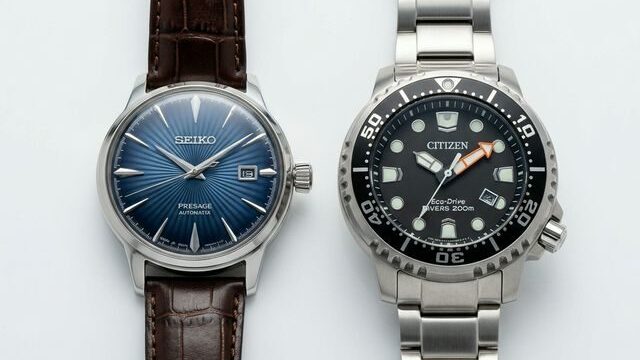
Seiko and Citizen are Japan’s two greatest watch manufacturers — and both offer extraordinary value at every price point. Whether you’re buying your first real watch or collecting affordable horological gems, these two brands dominate the under-$500 market. Here’s how they compare.
The Short Answer
Seiko specializes in mechanical movements and has stronger collector appeal — the Presage, Prospex, and Grand Seiko lines are revered by watch enthusiasts. Citizen excels in practical, everyday technology — Eco-Drive solar power means you never change a battery. Seiko for watch lovers; Citizen for convenience lovers.
Side-by-Side Comparison
| Feature | Seiko | Citizen |
|---|---|---|
| Founded | 1881 (Tokyo) | 1918 (Tokyo) |
| Key Innovation | Spring Drive, first quartz watch (1969) | Eco-Drive (solar powered since 1976) |
| Entry Price | ~$50–$100 (Seiko 5) | ~$80–$150 (Eco-Drive basics) |
| Mid-Range | ~$200–$600 (Presage, Prospex) | ~$200–$500 (Promaster, Chandler) |
| High End | ~$3,000–$60,000+ (Grand Seiko) | ~$500–$3,000 (The Citizen, Campanola) |
| Movement Types | Mechanical, automatic, quartz, Spring Drive | Eco-Drive (solar quartz), some mechanical |
| Battery | Automatics: no battery. Quartz: standard battery | Eco-Drive: no battery changes (solar powered) |
| Collector Appeal | Very high (Seiko modding community, Grand Seiko) | Moderate |
| Best Diver | Prospex SPB series (“Baby MM”) | Promaster Diver BN0150 |
| Best Dress Watch | Presage Cocktail Time | Eco-Drive Stiletto |
Movements and Technology
Seiko is a powerhouse of movement innovation. They make everything in-house: mechanical, automatic, quartz, and the revolutionary Spring Drive (a hybrid that combines mechanical energy with quartz regulation for ±1 second per day accuracy). The Seiko 4R/6R movements in their mid-range are excellent value, and Grand Seiko’s 9S series rivals Swiss movements costing 10x more.
Citizen’s Eco-Drive is the single most practical watch technology ever created. It converts any light source into electrical energy — meaning you never need to change a battery or wind the watch. A fully charged Eco-Drive runs 6–12 months in complete darkness. For set-it-and-forget-it convenience, nothing beats it.
Value
Both brands offer incredible value, but in different ways. Seiko’s value lies in getting mechanical movements and in-house manufacturing at prices that Swiss brands can’t match. The Seiko Presage Cocktail Time offers a hand-finished dial and automatic movement for under $400 — comparable to Swiss watches costing $1,000+.
Citizen’s value lies in zero maintenance costs. No battery changes ($10–$30 saved every 2–3 years), no winding routine, and exceptional reliability. A $200 Citizen Eco-Drive will work perfectly for 20+ years with zero maintenance.
Which Should You Buy?
Choose Seiko if: You love mechanical watches and watchmaking. You want collector appeal and modding potential. You want the best value automatic watches under $500. You aspire to Grand Seiko as an endgame watch.
Choose Citizen if: You want zero-maintenance, set-and-forget convenience. You prefer solar-powered technology. You want a reliable daily watch that just works forever. You don’t want to think about winding or battery changes.
Frequently Asked Questions
Is Seiko better than Citizen?
Neither is objectively better — they excel in different areas. Seiko offers superior mechanical movements and collector appeal. Citizen offers superior convenience with Eco-Drive solar technology. For watch enthusiasts, Seiko is the preferred brand. For everyday practical use, Citizen is ideal.
How long does Citizen Eco-Drive last?
The solar cell itself lasts 20+ years. A fully charged Eco-Drive runs 6–12 months in total darkness. With regular light exposure (even indoor lighting), it runs indefinitely. The power cell may eventually need replacement after 15–20 years, costing about $30–50.

Axel Lander is the founder and editor of ReadySleek. He publishes practical guides on men’s style, grooming, and fragrance, with a focus on clear comparisons, value, and the trade-offs readers should know before deciding.