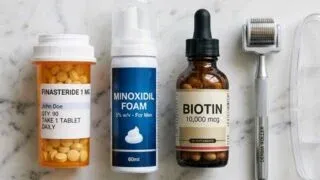
The internet is full of “natural hair loss cures” — from onion juice to essential oils to scalp massages. Most are nonsense. But a few natural approaches have genuine scientific evidence behind them. Here’s an honest breakdown of what works, what might help, and what’s a waste of time and money.
The Honest Truth About Natural Remedies
Let’s set expectations: no natural remedy is as effective as finasteride or minoxidil for androgenetic alopecia (male pattern baldness). If you’re losing hair rapidly, prescription treatments are your best bet. However, natural approaches can slow loss modestly, support hair health, and complement medical treatments. They’re best for men with mild thinning or those who want to try non-pharmaceutical options first.
What Actually Works (Evidence-Backed)
1. Microneedling (Derma Rolling)
Evidence: Strong. A 2013 study in the International Journal of Trichology showed that microneedling combined with minoxidil produced significantly better results than minoxidil alone. Even on its own, microneedling stimulates collagen production, releases growth factors, and increases blood flow to follicles. Use a 0.5-1.5mm derma roller on the scalp once per week. Don’t overdo it — your scalp needs time to heal between sessions.
2. Saw Palmetto
Evidence: Moderate. A 2020 meta-analysis found saw palmetto improved hair count in 60% of patients. It works as a mild 5-alpha reductase inhibitor (the same enzyme finasteride blocks), reducing DHT by approximately 30-40%. Take 320mg daily. It’s significantly weaker than finasteride, but the trade-off is virtually zero side effects.
3. Pumpkin Seed Oil
Evidence: Promising. A randomized, double-blind study published in Evidence-Based Complementary Medicine showed that men taking 400mg of pumpkin seed oil daily had a 40% increase in hair count over 24 weeks. The mechanism isn’t fully understood but likely involves mild DHT blocking. Available as oral capsules or topical oil.
4. Scalp Massage
Evidence: Moderate. A 2016 study showed that 4 minutes of daily scalp massage over 24 weeks increased hair thickness. The mechanism appears to be mechanical stimulation of dermal papilla cells, which regulate the hair growth cycle. Massage firmly with fingertips in circular motions for 5-10 minutes daily. Free, zero risk, and can be combined with any other treatment.
What Might Help (Weak Evidence)
| Remedy | Evidence | Verdict |
|---|---|---|
| Rosemary Oil | One study showed it comparable to 2% minoxidil after 6 months | Worth trying — apply to scalp, leave 30 min, wash |
| Caffeine (topical) | In-vitro studies show it stimulates follicles; limited clinical data | Low risk — try caffeine-based shampoos |
| Biotin | Only helps if you’re biotin-deficient (rare) | Skip unless blood test shows deficiency |
| Iron/Zinc/Vitamin D | Deficiency can cause hair loss; supplementation only helps if deficient | Get blood work done first |
| Green Tea (EGCG) | In-vitro DHT inhibition; no clinical trials | Drink it for general health; don’t expect hair growth |
What Doesn’t Work (Skip These)
Onion juice: One very small study exists. The smell alone makes compliance impossible. Coconut oil: Conditions hair and reduces breakage but does nothing for follicle miniaturization. Apple cider vinegar: Good for scalp pH balance but zero evidence for hair growth. Essential oil blends: Most have no clinical evidence. The one exception is rosemary oil (mentioned above). Hair growth gummies: Overpriced biotin with added sugar. Same biotin you can get for $5 in pill form.
The Best Natural Stack
If you want to try natural approaches before prescription medication, here’s the evidence-backed stack: Saw palmetto 320mg daily (oral) + pumpkin seed oil 400mg daily (oral) + microneedling 1x per week (0.5-1.0mm roller) + daily scalp massage (5-10 minutes) + rosemary oil (topical, 2-3x per week). Total cost: ~$25-35/month. Give it 6 months before evaluating results.
Frequently Asked Questions
Can natural remedies regrow hair?
Modestly, in some cases. Microneedling and saw palmetto have the best evidence for slowing loss and encouraging some regrowth. However, expectations should be realistic — natural remedies are roughly 30-40% as effective as prescription treatments. They work best for mild thinning rather than significant baldness.
Can you combine natural remedies with minoxidil?
Yes — and you should. Microneedling significantly enhances minoxidil absorption and effectiveness. Saw palmetto addresses DHT (which minoxidil doesn’t). Scalp massage improves blood flow. Natural approaches work best as complements to medical treatments rather than replacements.
Related Articles
- DHT Blockers: Do They Actually Work?
- Microneedling for Hair Loss: Complete Guide
- Finasteride vs Minoxidil: Which Is Better?
- Best Hair Growth Products for Men
- Does Creatine Cause Hair Loss?
Related: Hair Loss Treatment Resources

Axel is the founder of ReadySleek and has spent over 5 years researching and testing men’s grooming products, skincare routines, and hair loss treatments. His work combines hands-on product testing with insights from dermatologists and trichologists to deliver evidence-based grooming advice.
He specializes in men’s skincare (including ingredient analysis of retinol, niacinamide, and SPF), hair loss science (minoxidil, finasteride, hair transplants), men’s fragrance (with 80+ colognes personally tested), and body grooming techniques.
When he’s not reviewing the latest grooming products, Axel focuses on making complex grooming topics accessible and actionable for everyday guys.