Minoxidil is the most widely used hair loss treatment in the world – and one of only two FDA-approved medications for male pattern baldness. Originally developed as a blood pressure medication, its hair growth products effects were discovered as a side effect, and it’s been helping men fight hair loss since 1988.
But does it actually work? How do you use it correctly? What should you realistically expect? This guide covers everything, based on clinical research and real-world results.
How Minoxidil Works
Minoxidil works through several mechanisms that aren’t fully understood by scientists (even after 35+ years). Here’s what we know:
- Vasodilation – Opens blood vessels in the scalp, increasing blood flow and nutrient delivery to hair follicles
- Prolongs the anagen (growth) phase – Hair spends more time actively growing
- Stimulates follicle enlargement – Miniaturized (thinning) follicles partially reverse, producing thicker hair
- Opens potassium channels – May stimulate cellular processes that promote growth at the follicular level
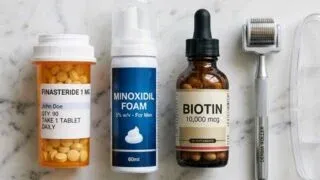
Importantly, minoxidil does not address the root cause of male pattern baldness (DHT blockers). It’s a growth stimulant, not a DHT blocker. That’s why combining it with finasteride (which blocks DHT) produces significantly better results than either medication alone.
Does Minoxidil Actually Work?
Yes – with realistic expectations. Here’s what clinical studies show:
| Metric | Result |
|---|---|
| Slows/stops hair loss | ~85% of men |
| Visible regrowth | ~40–60% of men |
| Significant (“cosmetically meaningful”) regrowth | ~10–15% of men |
| Works best on | Crown (vertex) thinning |
| Less effective for | Frontal hairline recession |
| Time to see results | 3–6 months (full effect at 12 months) |
Bottom line: Minoxidil is effective at slowing hair loss for most men. Significant regrowth happens for a smaller percentage, and results are strongest at the crown. It’s the accessible, low-risk starting point that every man with early hair loss should consider.
How to Use Minoxidil Correctly
Proper application makes a significant difference in results:
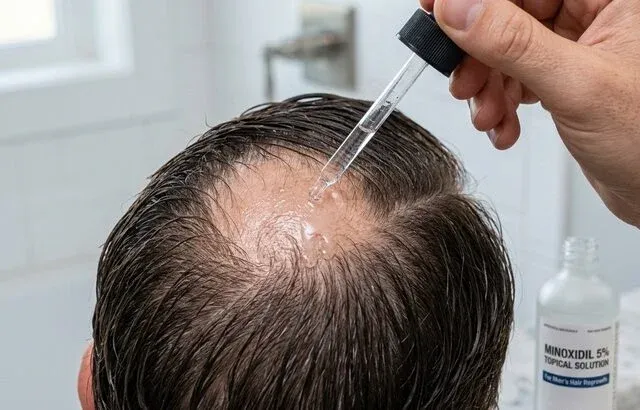
Topical Application (Foam or Liquid)
- Start with clean, dry hair. Wash your hair and allow it to dry completely, or apply to dry hair
- Apply 1 mL of solution (or half a capful of foam) to the affected area(s)
- Massage gently into the scalp with your fingertips for 30 seconds
- Wash your hands thoroughly to avoid unwanted hair growth on fingers/face
- Allow at least 2–4 hours to dry before sleeping (to avoid transferring to pillows/partner)
- Apply twice daily (morning and evening), approximately 12 hours apart
Foam vs. Liquid: Which Is Better?
| Foam | Liquid | |
|---|---|---|
| Ease of use | Easier – doesn’t drip | Harder – can drip down face |
| Drying time | Faster (~15 min) | Slower (~1–2 hours) |
| Propylene glycol | None (less irritation) | Contains PG (can cause itching) |
| Effectiveness | Equal | Equal |
| Cost | Slightly higher | Slightly lower |
| Best for | Sensitive scalps, active lifestyles | Budget-conscious, don’t mind drying time |
Recommendation: Foam is preferred for most men due to easier application and lower irritation risk. The liquid version is equally effective if you prefer it or want to save money.
Oral Minoxidil
Low-dose oral minoxidil (0.625–5 mg daily) is increasingly prescribed off-label by dermatologists. It’s more convenient (one pill daily vs. twice-daily topical application) and may be more effective for some men. However, it carries additional cardiovascular side effects and requires monitoring. Only available by prescription.
The Minoxidil Shedding Phase (Don’t Panic)
Many men experience increased hair shedding during the first 2–8 weeks of minoxidil use. This is called the “dread shed” and it’s actually a positive sign.
Here’s why: minoxidil pushes resting (telogen) hairs out of the follicle to make room for new, thicker growth. The shedding means the drug is working – those thin, miniaturized hairs are being replaced by healthier ones.
Timeline: Shedding typically peaks at weeks 2—4 and resolves by weeks 6–8. New growth starts replacing shed hairs around months 2–3.
Critical: Do NOT stop using minoxidil because of the initial shedding. Stopping at this point means you’ll lose the shed hairs plus any progress the medication was beginning to make. Push through.
Side Effects
Topical minoxidil has a very favorable safety profile. Most side effects are mild and local:
- Scalp irritation, dryness, itching (most common – usually from propylene glycol in liquid version; switch to foam)
- Initial shedding (temporary – see above)
- Unwanted facial/body hair growth (from minoxidil dripping onto face or transferring from pillow)
- Dizziness or lightheadedness (rare – due to vasodilation effect; more common with oral form)
- Water retention/swelling (rare – more common with oral minoxidil at higher doses)
Serious side effects are extremely rare with topical use. If you experience chest pain, rapid heartbeat, or significant swelling, discontinue and consult a doctor immediately.
What to Realistically Expect: Month-by-Month Timeline
| Month | What Typically Happens |
|---|---|
| 0–1 | Initial shedding phase. Hair may look worse before it gets better. This is normal. |
| 2–3 | Shedding stops. Early vellus (fine, light) hairs begin to appear in thinning areas. |
| 4–6 | Vellus hairs thicken and darken. First signs of visible improvement. |
| 6–9 | Noticeable improvement in density and coverage. Others may start commenting. |
| 9–12 | Near-maximum results. This is what your long-term results will look like. |
| 12+ | Maintenance phase. Continue use to maintain results indefinitely. |
Maximizing Your Results
- Combine with finasteride vs minoxidil – The combination is significantly more effective than either alone. Minoxidil grows hair; finasteride stops the underlying cause (DHT).
- Add microneedling – Weekly microneedling (1.0–1.5mm dermaroller) has been shown to boost minoxidil effectiveness by up to 4x by increasing scalp absorption.
- Be consistent – Apply twice daily, every day. Missing applications significantly reduces effectiveness.
- Apply to clean, dry scalp – Oil, styling products, and sweat impede absorption.
- Give it time – Judge results at 12 months, not 12 weeks.
What Happens If You Stop Minoxidil?
All gains from minoxidil are reversed within 3–6 months of discontinuation. Hair that was maintained or regrown by the medication will fall out, and you’ll return to wherever your natural hair loss progression would be.
This is a lifelong commitment. If you start minoxidil, be prepared to use it indefinitely – or accept that you’ll lose the progress when you stop.
Best Minoxidil Products
- Best foam: Rogaine 5% Minoxidil Foam – The original brand, easiest to apply
- Best liquid (budget): Kirkland 5% Minoxidil Solution – Same formula as Rogaine at half the price
- Best value foam: Kirkland 5% Minoxidil Foam – Generic Rogaine foam, excellent value
Frequently Asked Questions
Is generic minoxidil as good as Rogaine?
Yes. Generic minoxidil (like Kirkland brand) contains the identical active ingredient in the same concentration. The FDA requires generic medications to be bioequivalent to the brand name. Rogaine has a slightly smoother foam texture, but effectiveness is identical. Save your money and go generic.
Can I use minoxidil on my hairline?
You can apply it anywhere on the scalp. However, research shows it’s most effective at the crown (vertex) and less effective at regrowing the frontal hairline. Many men still apply it to the hairline and report modest improvements, especially when combined with finasteride and microneedling.
Does minoxidil work on beards?
Anecdotally, yes – many men use minoxidil off-label to stimulate beard growth in patchy areas. While not FDA-approved for this use, online communities report strong results. Applying minoxidil to the beard area follows the same principles as scalp application.
Can I use minoxidil and finasteride together?
Absolutely – this is the gold standard combination recommended by most hair loss specialists. Finasteride blocks DHT (the cause), while minoxidil stimulates growth independently. Together, they produce significantly better results than either alone. See our complete hair loss guide for treatment plan details.

Ready Sleek founder. Obsessed with casual style and the minimalist approach to building a highly functional wardrobe. Also a fan of classic, vintage hairstyles.