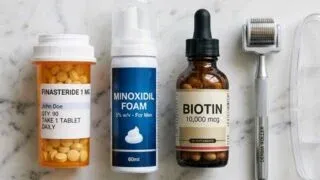
Finasteride is the most effective single medication for male pattern baldness. Originally developed to treat enlarged prostates (at 5 mg), the lower 1 mg dose (marketed as Propecia) was FDA-approved for hair loss in 1997 – and it remains the gold standard nearly three decades later.
But it’s also the most debated hair loss treatment because of potential sexual side effects. This guide gives you the full picture: how it works, how effective it is, the real risk profile based on clinical data, and what to expect if you decide to take it.
How Finasteride Works
Male pattern baldness is driven by DHT blockers (dihydrotestosterone), a hormone derived from testosterone. DHT miniaturizes susceptible hair follicles, causing them to produce progressively thinner hair until they stop producing hair altogether.
Finasteride works by blocking the enzyme 5-alpha reductase (type II), which converts testosterone to DHT. At 1 mg daily, finasteride reduces serum DHT levels by approximately 70% and scalp DHT by about 60%.
By cutting off the DHT supply, finasteride stops the miniaturization process. Follicles that haven’t fully died can recover, producing thicker, healthier hair over time.
This is fundamentally different from minoxidil, which stimulates growth without addressing the underlying cause. That’s why the combination of both is so effective – finasteride stops the destruction, finasteride vs minoxidil promotes the rebuilding.
How Effective Is Finasteride?
The clinical data is strong:
| Timeframe | Result (1 mg daily) |
|---|---|
| 1 year | ~86% of men maintained or improved their hair |
| 2 years | ~83% maintained or improved; ~66% saw visible regrowth |
| 5 years | ~90% maintained positive results from year 2 |
| 10 years | Most long-term users maintained significant improvement vs. baseline |
In clinical trials, finasteride increased hair count by an average of 107 hairs per cm² in the vertex area after 2 years, while placebo users lost 35 hairs per cm² – a net difference of 142 hairs.
Where it works best: Crown (vertex) and mid-scalp show the strongest results, but finasteride also demonstrates meaningful improvement at the frontal hairline – unlike minoxidil, which is weaker at the front.
Side Effects: The Honest Assessment
Side effects are the elephant in the room with finasteride. Here’s what the data actually shows:
Common Side Effects (2–4% of users)
- Decreased libido – reported by ~1.8% of men (vs. 1.3% on placebo)
- Erectile dysfunction – reported by ~1.3% (vs. 0.7% on placebo)
- Decreased ejaculate volume – reported by ~0.8% (vs. 0.4% on placebo)
Key context: In clinical trials, over 96% of men experienced no sexual side effects. Of those who did, the majority resolved after discontinuation – and in some cases, even while continuing the medication.
Post-Finasteride Syndrome (PFS)
PFS refers to persistent sexual, neurological, and psychological side effects that continue after stopping finasteride. This is a real concern that some men report, including persistent sexual dysfunction, depression, anxiety, and brain fog.
The science: PFS is controversial in the medical community. Several studies have found no evidence of persistent effects, while others (particularly patient-reported databases) suggest it occurs in a very small percentage of users. The exact incidence is unknown but appears to be extremely rare (estimated at less than 0.1–0.5% of users).
The balanced take: PFS is real for the men who experience it, even if the incidence is low. If you have a history of depression, anxiety, or sexual dysfunction, discuss this with your prescribing doctor before starting. Monitor your response and discontinue if you notice concerning changes.
Other Side Effects
- Breast tenderness/gynecomastia – Very rare (~0.1–0.3%)
- Depression/mood changes – Reported by some men; unclear if causally related
- PSA level reduction – Finasteride lowers PSA by ~50%. Inform your doctor if being screened for prostate cancer
How to Take Finasteride
- Dose: 1 mg once daily (this is the FDA-approved dose for hair loss)
- Timing: Same time each day, with or without food. Many men take it in the morning or just before bed.
- Prescription: Required. Available from your dermatologist, primary care, or telehealth providers like Hims, Keeps, or Roman.
- Cost: Generic finasteride: $5–30/month. Brand-name Propecia: $60–80/month. Generic is identical in effectiveness.
The “Cutting 5mg Proscar” Approach
Some men buy 5 mg finasteride (Proscar, prescribed for prostate) and cut the pills into quarters to get approximately 1.25 mg per dose. This is significantly cheaper – often $3–5/month. However, 5 mg pills aren’t designed to be split evenly, so dosing may vary. Discuss this approach with your doctor.
What to Expect: Timeline
| Month | What Typically Happens |
|---|---|
| 0–3 | No visible change. Some men experience mild shedding as the hair cycle resets. DHT levels begin dropping within days. |
| 3–6 | Hair loss slows noticeably. Some men see early thickening, especially at the crown. |
| 6–12 | Visible improvement in density and coverage. Hair appears thicker and healthier. |
| 12–24 | Maximum results. This represents your likely long-term outcome on finasteride. |
| 24+ | Maintenance phase. Most men maintain their year-2 results for 5–10+ years. |
Finasteride vs. Dutasteride
| Finasteride (Propecia) | Dutasteride (Avodart) | |
|---|---|---|
| 5-AR type blocked | Type II only | Type I and Type II |
| DHT reduction | ~70% | ~90% |
| FDA approved for hair? | Yes (1997) | No (used off-label) |
| Effectiveness | Excellent | Slightly superior (30% more regrowth in trials) |
| Side effect risk | Low | Moderately higher |
| Half-life | 6–8 hours | 5 weeks (persistent in body) |
| Typical use | First-line treatment | When finasteride alone isn’t enough |
Recommendation: Start with finasteride. If results plateau after 12–18 months and you want more, discuss switching to dutasteride with your doctor. The longer half-life of dutasteride means side effects (if they occur) take longer to resolve after discontinuation.
Who Should NOT Take Finasteride
- Women – Not approved for women. Pregnant women must not even handle crushed/broken finasteride tablets (risk of birth defects in male fetuses).
- Men planning children soon – Finasteride can reduce semen volume and sperm count. While most studies show these effects reverse after discontinuation, consider stopping 3 months before trying to conceive.
- Men with liver disease – Finasteride is metabolized by the liver.
- Men with history of severe depression – Discuss risks carefully with your doctor before starting.
Frequently Asked Questions
Is generic finasteride as effective as Propecia?
Yes. Generic finasteride is the identical molecule. The FDA requires bioequivalence testing for all generics. Save your money – generic is $5–15/month vs. $60–80 for brand-name Propecia.
What happens if I stop taking finasteride?
DHT levels return to normal within weeks. Hair loss resumes and any gains made on the medication are typically lost within 6–12 months. Finasteride is a lifelong commitment if you want to maintain results.
Can I take finasteride every other day to reduce side effects?
Some men and doctors use an every-other-day or three-times-a-week protocol to reduce side effect risk while maintaining reasonable DHT suppression. The evidence on this approach is limited but promising. One study found that 1 mg 3x/week produced similar hair counts to daily dosing. Discuss with your prescribing doctor.
Should I use finasteride AND minoxidil?
Ideally, yes. This is the gold standard combination – finasteride blocks the cause (DHT) while minoxidil stimulates growth independently. Studies consistently show the combination outperforms either medication alone. See our complete hair loss guide for detailed treatment plans by Norwood stage.

Ready Sleek founder. Obsessed with casual style and the minimalist approach to building a highly functional wardrobe. Also a fan of classic, vintage hairstyles.