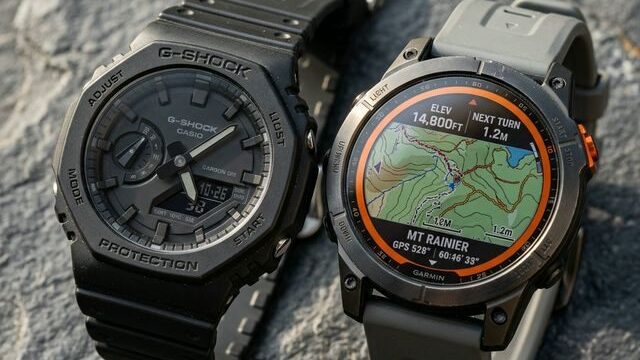
Casio G-Shock and Garmin are the two most popular rugged watch brands for active men. Both are virtually indestructible, both offer solar power and GPS capability — but they approach toughness from completely different angles. Here’s the full comparison.
The Short Answer
G-Shock is the original tough watch — designed to survive anything with legendary shock resistance, affordable pricing, and a no-compromise attitude to durability. Garmin is the smart fitness watch — GPS tracking, health metrics, topographic maps, and serious sports analytics in a rugged package. G-Shock for pure toughness and style; Garmin for fitness data and outdoor navigation.
Full Comparison
| Feature | Casio G-Shock | Garmin |
|---|---|---|
| Founded | 1983 (Japan) | 1989 (Kansas, USA) |
| Core Strength | Shock resistance, durability | GPS, fitness tracking, navigation |
| Price Range | ~$50–$600 | ~$200–$1,000+ |
| Battery Life | 2–10 years (solar = indefinite) | 5–25 days (varies by model/usage) |
| GPS | Select models only (Rangeman, Mudmaster) | Standard across line |
| Health Tracking | Basic (step count in newer models) | Comprehensive (HR, SpO2, sleep, stress) |
| Water Resistance | 200m standard | 100m typical (some to 100m+) |
| Shock Resistance | 10m drop test standard | MIL-STD-810 on some models |
| Smart Features | Basic (Bluetooth in select models) | Full smartwatch (notifications, apps, maps) |
| Popular Models | GA-2100 “CasiOak”, DW-5600, Rangeman | Fenix 8, Instinct 2, Forerunner 965 |
Durability
G-Shock is in a class of its own. Designed to survive a 10-meter drop onto concrete, G-Shocks have been run over by trucks, frozen, burned, and dropped from buildings in real-world tests. Solar-powered models (Tough Solar) run indefinitely with light exposure. A G-Shock can genuinely last 20+ years with zero maintenance. The 200m water resistance is standard across the range.
Garmin watches are tough — particularly the Fenix and Instinct lines (MIL-STD-810 rated) — but they’re electronics with touchscreens and sensors that are inherently more fragile than a G-Shock’s resin construction. Battery degradation over 3–5 years is inevitable. Garmin watches are durable tools, but not indestructible ones.
Fitness and Smart Features
Garmin dominates here. GPS tracking, heart rate monitoring, blood oxygen, sleep analysis, training load, recovery time, topographic maps, and smartphone notifications. For runners, hikers, cyclists, and gym-goers, Garmin provides data that G-Shock simply doesn’t offer.
G-Shock is a watch — it tells time, sets alarms, and maybe counts steps in newer Bluetooth models. It doesn’t try to be a fitness computer. For many men, that simplicity is the appeal — no chargers, no software updates, no distracting notifications.
Which Should You Buy?
Choose G-Shock if: You want the toughest watch ever made. You prefer no-maintenance (solar = never charge). You want a watch that’s purely a watch. You value affordability ($50–$200 for excellent models).
Choose Garmin if: You want GPS, fitness tracking, and health data. You’re a serious runner, hiker, or cyclist. You want smart notifications and maps on your wrist. You’re willing to charge regularly and accept electronics lifecycle.
Frequently Asked Questions
How long do G-Shock watches last?
Standard G-Shocks last 10+ years easily. Solar-powered models (Tough Solar) can last 20+ years since they don’t need battery changes. The resin case and crystal are extremely durable. Many people wear the same G-Shock daily for a decade without issues.
Is Garmin better than Apple Watch for fitness?
For serious fitness, yes. Garmin offers superior GPS accuracy, longer battery life (weeks vs hours), more sport-specific metrics, and tougher construction. Apple Watch is better for general smartwatch features and iPhone integration. For runners and outdoor athletes, Garmin is the clear winner.

Axel Lander is the founder and editor of ReadySleek. He publishes practical guides on men’s style, grooming, and fragrance, with a focus on clear comparisons, value, and the trade-offs readers should know before deciding.