Microneedling has gone from a niche dermatology procedure to one of the most promising hair loss guide treatments available. Studies show that combining microneedling with minoxidil produces 4x more hair regrowth than minoxidil alone. That’s a remarkable boost for a treatment that costs under $100 total.
Here’s how it works, how to do it safely, and what results to expect.
How Microneedling Works for Hair Loss
Microneedling (also called derma rolling or collagen induction therapy) creates tiny controlled punctures in the scalp using fine needles. This triggers three mechanisms that promote hair growth:
- Wound-healing response – The micro-injuries trigger your body’s repair cascade, releasing growth factors (PDGF, EGF, FGF) that stimulate dormant follicles
- Collagen remodeling – New collagen production around hair follicles strengthens the follicular environment
- Enhanced absorption – The microchannels increase minoxidil absorption by up to 5x, dramatically improving its effectiveness
The Science: Study Results
| Study | Protocol | Result |
|---|---|---|
| Dhurat et al. (2013) | 1.5mm microneedling weekly + 5% minoxidil | 4x more hair regrowth vs. minoxidil alone after 12 weeks |
| Kumar et al. (2018) | 1.5mm biweekly + 5% minoxidil | Significant improvement in hair density and thickness |
| Faghihi et al. (2020) | 0.6mm + 5% minoxidil | Greater hair density improvement than minoxidil alone |
The most cited study (Dhurat 2013) is particularly impressive: participants who had previously failed minoxidil-only treatment showed significant new growth when microneedling was added.
At-Home Microneedling Protocol
What You Need
- Device: Derma pen (motorized) is preferred over derma roller for scalp use. Pens create vertical punctures; rollers create angled tears. Pen recommendation: Dr. Pen M8S (~$70)
- Needle depth: 1.0–1.5mm (optimal for hair loss based on studies)
- Needle cartridges: 12-pin or 16-pin for scalp coverage
- Disinfectant: 70% isopropyl alcohol to sterilize before and after
Step-by-Step Protocol
- Clean your scalp – Wash hair and let it dry. Alcohol-swab the treatment area
- Sterilize the device – Soak needle cartridge in 70% alcohol for 5–10 minutes
- Set depth to 1.0–1.5mm – Start at 1.0mm if new to microneedling, work up to 1.5mm
- Needle the thinning area – Move the pen slowly across each zone in 4 directions (vertical, horizontal, diagonal both ways). Each pass should take 2–3 minutes per area
- Target: mild pinkness/redness – Some pinpoint bleeding is normal at 1.5mm. Stop if you see significant bleeding
- Aftercare – Do NOT apply minoxidil for 24 hours post-session (it stings and could cause irritation). Let scalp heal for 24 hours before applying any topical
Schedule
| Day | Microneedling | Minoxidil |
|---|---|---|
| Monday | ✅ Session | ❌ Skip (24h post-needling) |
| Tuesday | ❌ Rest | ✅ Resume AM + PM |
| Wed–Sun | ❌ Rest | ✅ AM + PM |
Frequency: Once per week at 1.0–1.5mm depth. Do NOT microneedle daily – the scalp needs 5–7 days to complete the wound-healing cycle that stimulates growth.
What to Expect
- Weeks 1–4: Mild shedding possible (similar to minoxidil shed). Scalp may be tender for 24–48 hours post-session
- Weeks 4–8: Shedding stops. Early vellus (fine, thin) hairs may appear
- Weeks 8–12: Noticeable improvement in density. Vellus hairs begin maturing to terminal (thicker) hairs
- 3–6 months: Significant results visible. Most improvement occurs in this window
- 6–12 months: Peak results. Continue weekly sessions to maintain
Safety and Pain
Pain level: Moderate discomfort. Most describe it as a “prickly” or “scratchy” sensation. At 1.5mm on the scalp, it’s uncomfortable but tolerable. No numbing cream needed for most men, though topical lidocaine can be applied 30 minutes before if pain-sensitive.
Side effects: Temporary redness (12–48 hours), mild swelling, occasional pinpoint bleeding. All normal. Do not microneedle over: active acne/infections, sunburned skin, open wounds, or irritated areas.
Frequently Asked Questions
Can I microneedle without minoxidil?
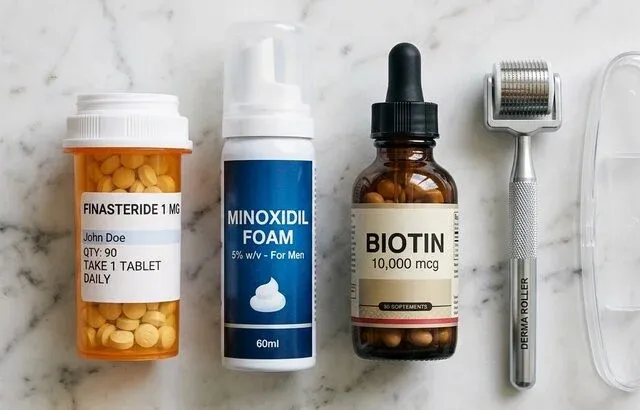
Yes. Studies show microneedling alone produces modest hair growth improvement through its wound-healing and growth factor mechanisms. However, the best results by far come from combining microneedling with minoxidil. Adding finasteride to this protocol creates the most comprehensive non-surgical approach. See our best hair growth products guide for the full recommended stack.
Derma pen vs derma roller: which is better?
Derma pen (motorized) is better for scalp use. It creates precise vertical punctures, is easier to use on hair-covered areas, and allows adjustable depth. Derma rollers work but create angled entry/exit wounds that cause more tissue damage and are harder to maneuver through hair.
How long do I need to continue?
Indefinitely, like any hair loss treatment. Results gradually reverse if you stop. Many men reduce frequency to biweekly once they’ve achieved their desired results, using weekly sessions for the first 6–12 months then maintenance sessions every 10–14 days.

Ready Sleek founder. Obsessed with casual style and the minimalist approach to building a highly functional wardrobe. Also a fan of classic, vintage hairstyles.