
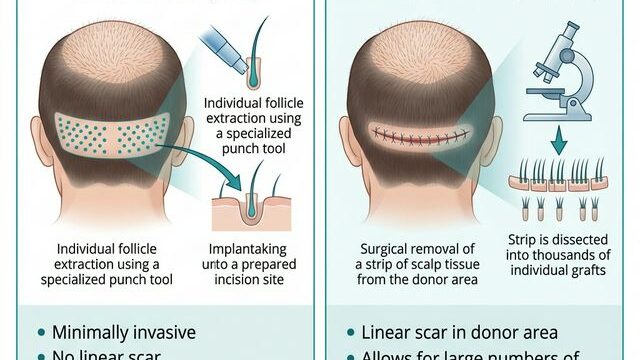
FUE and FUT are the two main hair transplant methods — and choosing between them is one of the biggest decisions you’ll make on your hair restoration journey. Both work, but they differ significantly in scarring, recovery time, cost, and results. Here’s an honest, unbiased comparison to help you decide.
FUE vs FUT at a Glance
| Factor | FUE (Follicular Unit Extraction) | FUT (Follicular Unit Transplantation / Strip) |
|---|---|---|
| How it works | Individual follicles extracted one by one | Strip of scalp removed, follicles dissected from strip |
| Scarring | Tiny dot scars (nearly invisible) | Linear scar on back of head (can be hidden by hair) |
| Recovery time | 5-7 days | 10-14 days |
| Pain level | Lower | Moderate (strip removal) |
| Grafts per session | 2,000-4,000 | 3,000-5,000+ |
| Surgery time | 6-10 hours | 4-6 hours |
| Cost (USA) | ~$8,000-15,000 | ~$5,000-10,000 |
| Can buzz head after? | ✅ Yes (no visible scar) | ❌ No (linear scar visible) |
| Best for | Smaller areas, younger patients, those wanting short hair | Maximum grafts, larger areas, budget-conscious |
FUE: Follicular Unit Extraction
FUE extracts individual hair follicles from the donor area (back and sides of the head) using a tiny punch tool (0.7-1.0mm). Each follicle is transplanted individually into the thinning area. Pros: Minimal scarring — tiny dot scars that are virtually invisible even with short hair. Faster recovery (5-7 days vs 10-14 for FUT). Less post-operative pain. Can harvest from beard and body (in some cases). Cons: More expensive ($8,000-15,000 vs $5,000-10,000). Longer surgery time (6-10 hours). Slightly lower graft survival rate in some studies (90-95% vs 95-98%). May require larger donor area to be shaved.
FUT: Follicular Unit Transplantation (Strip Method)
FUT removes a strip of skin (typically 1-1.5cm wide, 15-30cm long) from the back of the head. A team of technicians then dissects individual follicular units from this strip under microscopes. The strip wound is closed with stitches. Pros: More grafts per session (3,000-5,000+). Higher graft survival rate in many studies. Shorter surgery time (4-6 hours). More cost-effective per graft. Ideal for patients needing maximum coverage. Cons: Linear scar on the back of the head — can be hidden by hair at 1+ inch length, but visible with a buzz cut. Longer recovery (10-14 days, stitches removed at day 10). More post-operative discomfort. Not suitable if you want to wear very short hairstyles.
Which Should You Choose?
Choose FUE if: You want to wear short hairstyles (buzz cuts, fades) in the future. You have a smaller area to cover (Norwood 2-3). You prioritize minimal scarring. You can afford the higher cost. You want faster recovery. Choose FUT if: You need maximum grafts for larger coverage (Norwood 4-6). Budget is a major factor. You always keep hair at 1+ inch length (scar hidden). You want the highest possible graft survival rate. You’re okay with a longer recovery period.
Frequently Asked Questions
Can you do both FUE and FUT?
Yes — some surgeons recommend FUT first to get maximum grafts, followed by FUE later for touch-ups or to address the FUT scar. This is called a “combo approach” and can maximize total graft yield from the donor area over multiple sessions.
How long until results are visible?
Both methods follow the same timeline: transplanted hair falls out at weeks 2-4 (this is normal — “shock loss”), starts regrowing at months 3-4, and reaches full density at 12-18 months. Final results take patience — judge at the 12-month mark, not at 3 months.
Related Articles
- Hair Transplant: Cost, Methods, Recovery
- Norwood Scale: Identify Your Stage
- Finasteride vs Minoxidil
- Scalp Micropigmentation Guide
- DHT Blockers for Hair Loss

Axel Lander is the founder and editor of ReadySleek. He publishes practical guides on men’s style, grooming, and fragrance, with a focus on clear comparisons, value, and the trade-offs readers should know before deciding.